OK Folks. I promised it. So here it is: me doing the first third of the Yang tai chi set. The initiated will be able to see the weaknesses and mistakes (which I myself can see), but my form has "stabilized" into the state it will be in for a while. This is what I do every morning (three times) after I warm up with twenty minutes of Chi Kung exercises.
The outfit I'm wearing is my Easter Sunday outfit. I had my son take this video while we were there for family dinner. There's a strong tradition among some Chinese wu shu masters that they never wear uniforms, and only train in everyday clothes. I've worn theses clothes to the office, so that's fairly everyday.
Showing posts with label yoga. Show all posts
Showing posts with label yoga. Show all posts
March 23, 2008


March 4, 2008
Of heptads, rebirth, solar energy, tai chi and everything
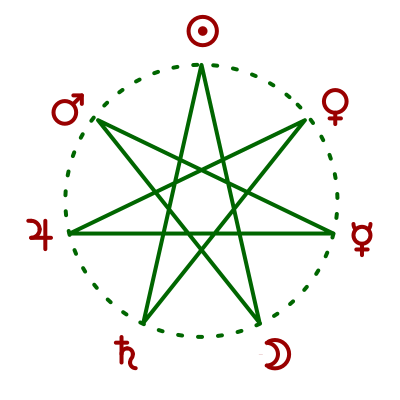 It's a special day today. I'm buzzing with enthusiasm. Now lots of people – especially in our youth-oriented culture – would say I'm completely nuts about being happy it's my 49th birthday today. But I am. I've been looking forward to this day for weeks.
It all has to do with cycles of seven. Rosicrucian teachings say that human life unfolds in cycles of seven. First of all, there are seven days in the week. Then the years can be divided into seven periods of 52 days each, and then there are cycles in our lives consisting of seven years each. Anthroposophists and Waldorf teachers and parents will be familiar with the latter. Well... I have now finished the last year of a seventh cycle of seven. Something very "complete" about that. And what makes this year, and especially this day, so special?
Look at the star illustrating this posting. That star can be found in the Occult Philosophy of the Renaissance mystic/philosopher/magician Cornelius Agrippa, along with explanations of how to use it to calculate the planetary influences of a given day and hour. Every week starts with the day of the sun (Sunday), followed by the day of the moon (Monday) and so forth, following the lines of the star. The first hour of Sunday is the hour of the sun, followed by the hour of venus, following the points of the star clockwise. There are 24 cycles of seven hours per week, bringing you back to the hour of the sun in the first hour of the week. So, obviously the first year of each cycle is a solar year, and the first cycle of seven years is the solar cycle. So... I have gone through seven cycles, meaning this new cycle of seven is a solar cycle. This is the first year of that cycle, so this is the solar year, And this is the first 52 days of that year, so this the solar section of that year. And it's the very first day!
I am reborn today!!!
The wind is in my sails! And I know I had better take advantage of this, and use all this energy wisely, because times of such positive momentum are precious. Honestly. I feel an electric buzz all through my body and mind.
It was thinking a few days ago that I needed to do something special to mark this occasion, when I got a serious brain wave. And here's what occurred to me.
As my loyal readers know, I started relearning the Yang tai chi form about five weeks ago. I say "relearning" since I learned a short version of the Yang form in an Experimental College class at UC Davis, back when I lived in northern California. First of all, that was twenty years ago, and I didn't really remember much of it anymore. And I don't recall – if I ever knew – what particular style of Yang tai chi my teacher taught, but it wasn't as rigorous, nuanced, or detailed as the form taught on the videos of Erle Montaigue. Essentially, I had to learn it over from scratch.
Well, two days ago it occurred to me that I was only two moves away from finishing the first third of the Yang Cheng set, which is considered to be a short set in an of itself. I realized that if I busted my butt and learned the last two moves, I could do the whole set. That represents an accomplishment to me. Five weeks of daily work to not only regain something I could do in my late twenties, but to even learn it at a higher level than I could do it back then.
For the first time, this morning, the first day of the first 52-day cycle of this first year of the second solar seven-year cycle of my life (hope you could follow that), I performed my new Yang Cheng Fu tai chi set. It was still dark outside, and my family was still asleep, but I felt vibrant. What a wonderful birthday present to myself!
In a few weeks, once I've ironed some of the nastier wrinkles out of the form, I'll have my son make a video of me doing the routine, and I'll upload it to the blog.
I'll have a big party next year to celebrate my 50th, but that'll be for everyone else. This year's the important milestone to me.
February 13, 2008
Evolving a Relationship to Fairy Tales (Part VI)
 (Werner Zurfluh, Part II)
There are two ways in which Zurfluh's work relates to fairy tales.
Zurfluh claims that collections of traditional fairy tales contain numerous examples of slightly coded instructions regarding the virtues of maintaining awareness in the "realms of the night". And, indeed, if you examine the vast treasure of recorded fairy tales, you'll find that a great many of them hinge on things which occur around the time a character in the tale falls asleep. An inordinate amount – one might even say a suspicious amount – of sleeping goes on in fairy tales. But you never notice until your attention is drawn to this fact.
A case in point: last night I read my children "Habetrot and Scantlie Mab" (from More English Fairy Tales, ed. Joseph Jacobs, 1894). Wouldn't you know that the main character "falls asleep" by a knoll while despairing over how to perform a task her mother has set her? She "wakes up" to the voices of some people in a cave she can see through a hole in a rock. These people are performing the task for her. This motif -- a task being performed for someone while they sleep -- occurs again and again in traditional fairy tales.
Zurfluh argues that the tales teach the technique of maintaining awareness, and not going "unconscious," as one slips into "the realms of the night". He draws attention to the Grimm’s tale "The Worn-Out Dancing Shoes", in which a soldier takes on the challenge of finding out where seven princesses are slipping away to at night, despite being under lock and key. The princesses have foiled previous attempts by giving their chaperon a glass of drugged wine before bed. By means of a trick (a sponge tied under his chin) he only pretends to drink the wine and fall asleep, but stays awake, and fakes snoring. In this way he is able to follow the princesses into the fantastic world reached by a ladder under one of their beds. Zufluh says this is an admonishment to maintain continuity of ego while falling asleep. There are many more tales in which the characters achieve amazing feats when they fall asleep, or deliberately don't fall asleep.
Another thing he tells us to pay attention to is passages in tales in which the hero arrives at a gate, a wall, a border or any other symbolic threshold. This, he says, is the transition into the other world, at which one must maintain awareness, or risk falling into an ordinary, non-lucid dream state. The hero is usually armed with a magic word, a power object or some other means of passing through the barrier. On the day I read those remarks in Zurfluh, that evening I read my children "The Three Heads of the Well” (English Fairy Tales, Ed. Joseph Jacobs, 1890). In this story, after the heroine proves that she has a good heart by sharing her meager travel provisions with a hungry old man, the man tells her, "There is a thick thorny hedge before you, which you cannot get through, but take this wand in your hand, strike it three times, and say, 'Pray, hedge, let me come through,' and it will open immediately." (I suspect this could be adapted as a visualization for breaking through into the other world with awareness intact. I'll let you know if it works!)
These practices were known in ancient times because, he says, ancient societies always had a certain class of people, mostly known as shamans and priests, who were privy to this knowledge. It later became necessary to code this information because of the persecution of the church, which regarded such practices as witchcraft and sorcery. But once one knows what one is looking for, he says, the message in fairy tales about lucid dreaming is fairly obvious. And I agree.
The other connection between Zurfluh and fairy tales is his perspective on the source of fairy tale content. He is very much in agreement with Steiner that they are retellings of psychic experiences. In his essay "Über den Ursprung der Märchen" ("On the Origins of Fairy Tales"), Zurfluh says that it’s a mistake to look for the origins of fairy tales in historical or folkloristic terms. He regards all arguments over the comparisons of various versions of tales, most of which have only been committed to writing during the last few centuries, to be very academic. He asserts that fairy tales originate in the experiences of those individuals who manage, through hard effort and training (meditation, dream recording, cultivating proper sleep conditions) to penetrate into the realms of the night with their awareness intact, which consequently means they return from such experiences with memory of them intact.
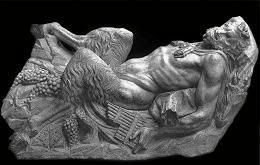 In this essay, he presents a passage from his journal which records his experience of visiting the "Land of the Fauns." He is of the view that the beings he encountered were the actual fauns of classical myth, and that this land (this "plane") exists apart from the material plane. Anyone who develops the proper skills and discipline can visit this world, or any of the other worlds depicted in myths and tales, because they really exist.
And so I've brought you to the point I've reached at this point in my relationship with fairy tales. I'm very pleased that my youthful suspicions concerning their importance to spiritual growth have panned out. Since, besides the other three children who still live under my roof, I still have a 1 1/2-year-old boy, I look forward to reading fairy tales nightly for many years to come. And now that I have been given so many keys from the researches of others, I fully expect that relationship to continue growing and changing.
(Next: conclusions and finals words)
Evolving a Relationship to Fairy Tales (Part V)
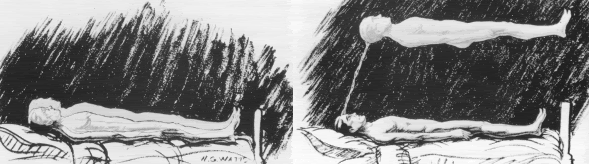
(Werner Zurfluh, Part I)
My research into the more mystical aspects of fairy tales led me to the work of Werner Zurfluh, an intriguing explorer of consciousness. The majority of his previously-published German-language works are available on the internet in html format (unfortunately little of it translated into English, and the translations are of substandard quality). Though he is very well-versed in the literature of mysticism, meditation and eastern philosophy, and despite the fact that his works are heavily annotated, the power of what he says in his writings comes from the fact that it is based on his own inner experiences, and does not rely on anyone else’s authority. A large portion of the text consists of extracts from his journals.
Zurfluh, as a child, was prone to Out of Body Experiences (OBEs), or what is also called astral projections, and he had many of them until he was a young adult. During his student years, he noted that due to the stress of intellectual work these experiences stopped and his internal experience became confined to "conventional" dreams. He resigned himself to the situation and later began occupying himself with Jungian interpretation of his dreams. With time, however, he came to the conclusion that this was the wrong way to go about things.
Zurfluh's main theme, in almost all of his published writing, emphasizes the importance of striving for personal experience of those states of mind called dreams (especially lucid dreams), astral projection, and OBEs. Because of his own background as a biology teacher and due to several years of study at the Carl Jung Institut in Switzerland, he spends a lot of his time arguing against the tenets of mainstream materialistic science and psychology, including depth psychology. He is critical of today's science because of its inability to work with, acknowledge, or even entertain the possibility of anything that cannot be measured with state-of-the-art instruments (in spite of the fact that "science" acknowledges all sorts of things now that could not be measured as recently as a decade ago), and he faults depth psychology for still falling into the Aristotelian trap of analysing and categorizing internal experiences in ways that kills them and makes them empty shells like so many mounted butterflies.
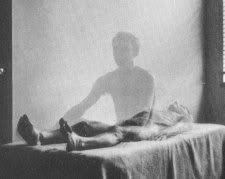 In his works he sites hundreds of pages of dream-, lucid dream- and OBE experiences that show a progression over time (many years, in fact). At first he utilized the standard sort of Jungian analysis on his dreams, and the symbols and sequences yielded exactly the type of results a Jungian analyst would expect. But with time, and by applying the lessons these experiences were teaching him, he began to understand that these "internal" experiences are, to a surprising extent, subject to the "observer effect". When he was expecting content that lent itself to Jungian analysis, that is exactly what he got.
But once he had spent more time simply observing, and putting his efforts into being as aware as possible in whatever state of consciousness he happened to be, the nature of his experiences changed dramatically, and he began to understand that these states are not just subjective (i.e. just going on in your head), nor purely objective (i.e. something you are perceiving which exists outside of you), but a subtle interaction of the two. Fact is, he says, sometimes the things one encounters in these experiences are astral beings. They might be other people journeying in those worlds, or other kinds of beings which have been called spirits, elementals, genies, djinn, demons, angels, fairies and many other things throughout the ages. It's not appropriate to treat these like some aspect of yourself, as many depth psychologists might advise, because then you will not really find out what they wish to communicate to you.
So, rather than torture the symbols of dreams for hidden meanings -- using the logic of the material world to analyze and interpret otherworldly experience -- he determined that it was more important to make every effort possible to maintain the continuity of ego (Kontinuierlichkeit des Ichs) while entering the "realms of the night," as he calls them. One must, as much as possible, maintain an awareness of one's own identity, as well as an awareness of the otherworldly nature of one's state of consciousness when one leaves the ordinary waking state. This seems paradoxical to those who have not had this experience: being "awake" while one is asleep. His techniques encompass both what is known as astral projection, and what dreamworkers refer to as working with hypnagogic imagery.
(Next: Werner Zurfluh on fairy tales)
January 30, 2008
Different Strokes...
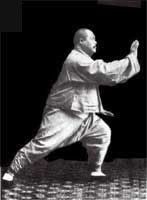 I've had a change of heart. The Carradine DVD got me turned on to the idea of doing tai chi again (see previous post), and it was cool trying out some of the moves his sifu teaches. I even learned some nice warm-ups and stretches I never knew before.
But...
My years of being a dedicated martial arts student, although over a decade ago now, left an indelible imprint on me. As I tried to practice the form every morning, I kept coming up with more and more questions. "How do I get from this posture to that posture? Is that accompanied by an in-breath or an out-breath? Which way is the left foot pointed at that moment. How are the hands held when you do that motion." So, on the weekends I would pop the DVD into the computer and study what the sifu does as well as I could. And I got frustrated. Not enough clarity. I had an approximate idea of how it's done, but not close enough.
I kept looking at video clips on the internet of Chen style tai chi sets. Beautiful. Smooth. Stunning explosive strikes (fa jing) that erupt out of slow deliberate motions. I got some pointers, but... still not enough.
And I realized there were some things about Chen style that I just couldn't understand because they seemed to contradict what I'd learned in Yang Style.
And I realized there were some things about Chen style that I just couldn't understand because they seemed to contradict what I'd learned in Yang Style.
Then one day I stumbled onto this video. And I was immediately drawn to this man. (First of all I love the Australian accent, since I had a close "mate" from Australia for several years. But that's beside the point.)
His name is Erle Montaigue, and once I looked into his background, it turns out he's a martial artist's martial artist. Mr. Montaigue is a proponent of teaching tai chi as a serious (and potentially deadly) martial art, as opposed to tai chi-as-new-agey-fitness workout. Now I have the greatest respect for Arnold Tayam. What he does on Carradine's DVDs shows that he is a serious martial artist, but once I started watching Montaigue, I realized that this was the genuine article, and the Carradine material was designed to tap a certain market, which doesn't necessarily consist of serious martial artists.
What I like about this video, as opposed to the Carradine video, is that it's so un-Hollywood. Just a guy standing in front of a camera carefully demonstrating martial arts moves and explaining vital details as he goes along. This is what sitting in a martial arts class is like. No slick production values like music and a pretty set. Nope. Just tai chi instruction. If that's what you're there for, that's what you get. And very precise instruction at that.
I started doing the Yang Cheng Fu set again, adding one move a day. It was a bizarre experience when I executed Push Left and then flowed into Ward off Right for the first time in twenty years. Synapses fired in places in my brain I forgot I had synapses. My body had that sensation of getting on a bicycle after not having ridden one for years: that odd but delightful feeling of familiarity.
I cruised on over to Erle's website. Can you believe he has over 300 instruction DVDs for sale? Not to mention free e-books. And an interesting marketing strategy. A great deal of his instruction DVDs are available on his website in Windows Media format. If you can't handle the small image and the compression distortion, then you can buy the DVDs for £ 33 each. That's steep, but you have to consider that he gives you the opportunity to see them for free if you want. They'll mail anyone all the clips (in Windows Media format) of the Yang Cheng Fu form for free, so I ordered it. (You can see the whole Yang Cheng Fu set on his website, too). I know very well that a year or two from now I'll want to shell out full price for the DVD of the Yang Lu-ch'an form (the older, more difficult Yang style), but that's fair enough. Good marketing strategy. And good karma, too, since he's not selling worthless trinkets.
I've learned something important about myself. If given the choice of how I want my tai chi, make mine a serious martial art.
January 23, 2008
Goin' to the Dogs... Chinese Style!
 Folks, it's confession time. Remember how enthusiastic I was about The Five Tibetans? Well... er...
You see, there I was: out doing some family shopping with my wife and our one-and-a-half-year-old son during my long vacation at the Christmas holidays. I was wandering down an aisle of the drug store, pushing a shopping cart with my adorable son in the seat (the mention of the adorable son is supposed to elicit sympathy, you should realize), idly looking at this and that while Szilvi grabbed diapers, body lotion, whatnot. I was just minding my own business when all of a sudden I was ambushed, and ruthlessly attacked by a DVD, and it twisted my arm behind my back until I went to the cashier and bought it! Well,... Ok, wasn't quite like that. The end cap of one aisle had a small pile of discounted DVDs on it, in which I found a Hungarian-dubbed version of David Carradine's Tai Chi for the Body. It was ridiculously cheap. So I said to myself, why the heck not. I watched the odd episode of Kung Fu when I was a kid. Carradine's been practicing martial arts most of his life. He must know what he's doing. So I bought it.
I wouldn't have dared to attempt learning tai chi from a video, if it weren't for the fact that I practiced aikido for eight years and did some cross-training in tai chi during that time. When I was a brown belt (second and first kyu) I decided that tai chi would help improve my technique. I took a class in which I learned a 24-move Yang-style form. It took me days of searching videos on the internet to find the form I learned, because there are so many, but when I was just about ready to give up I finally discovered it. If you look at the top video on this page, you can see the form, although I could never do it as smoothly as this guy. It did really improve my aikido, too. I can't resist a little digressive anecdote. At maybe the second or third tai chi lesson, the teacher asked me if I practiced aikido. When I confirmed her suspicions, she smiled and said she could see that I moved like an aikidoist the moment I started doing tai chi motions. It was like I was speaking a foreign language with a heavy accent.
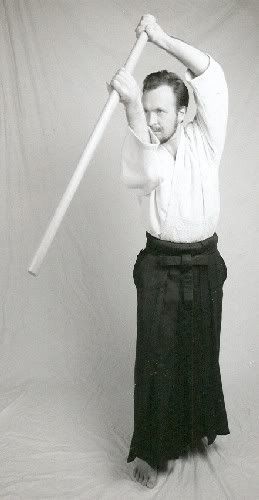
Anyway, I thought I could learn from a DVD because I already had plenty of experience with such aspects of martial technique as moving from tan tien (center), extending chi, coordinating movement and breath, shifting weight from leg to leg, and relaxing while in motion.
When I got it home I popped the disk into the laptop and was seriously peeved to find they didn't keep the original English-language version on the DVD. (Usually I can buy any Hungarian DVD of an English-language film, and the original is still available in the menus. Must be a copyright issue.) But then I started doing the exercises, despite the fact that the voice-over was in Hungarian (instead of Mr Carradine's dulcet tones), and I really started digging it.
Carradine is at the front of a room with three other people behind him: a very young woman who moves like a beginner, a middle-aged woman who has more grace and confidence, and a middle-aged Asian man, who is suspiciously smooth. It turns out that the Asian man is Arnold Tayam, Carradine's sifu. He's a martial artist, ki gong master and physician, with decades of experience in each. As the video rolls, the camera concentrates less and less on Carradine, and more and more on Tayam. Star power sells the DVD, but Tayam provides the quality content.
The presentation is very well thought out. It starts with stretches, then moves on to stances. After that it demonstrates simple techniques that you can repeat over and over. In the end, it takes all the little pieces you learn throughout the lesson, and ties them together into a short Chen tai chi form (a routine, or as the Japanese would call it: a kata). I haven't started working on the complete form yet. I'm still practicing all the little pieces and stances.
I was so jazzed about learning this stuff that I began doing it the very next morning for my morning routine, and... well... I dropped the Five Tibetans like a rock.
Why? Well, for one, I just find getting back to tai chi to be much more satisfying. Slowly flowing through those graceful figures while deeply pulling air in and out of the lungs all the way down to the diaphragm is much more harmonious than doing what amounts to repetitive glorified calisthenics that just move from one position to another and back again. Despite the fact that the Tibetans have a positive effect, they become a boring chore after a while.
And another is that one has to weigh the positive effects of the Tibetans against the negative. I began noting sensations that struck me as symptoms of repetitive motion syndrome. The downward dog to upward dog motion was making the carpal area of my right hand sore. I've seen ads on the Internet for cork blocks with handles one can hold while doing those yoga poses to avoid this stress, so it must be a common problem. It also struck me as odd how much counter exercise was needed to strengthen the lower back muscles to withstand the stress of the Tibetans put on them.
It's true that I felt good after doing the Tibetans, but it was a sort of heart-pumping, muscles-throbbing, lungs-gasping kind of feeling. With the tai chi, after 45 minutes of smooth movement and deep breathing I have an energized "electrical" feeling. And it seems to last longer.
I may or may not experiment with the Tibetans again in the future, but for now I want to do something that's more interesting and fills me with a sense of cosmic beauty. Now pardon me while go reel some silk.
November 9, 2007
Goin' to the dogs - 2nd interlude
When anyone mentions the negative effects the "Tibetans" might have, back pain is usually at the top of the list. As I mentioned in a previous posting, this is most likely due to two factors. The first is that the exercises quickly strengthen the abdominal muscles without balancing this out by strengthening the back (especially the lower-back) muscles. The second factor is that our contemporary lifestyle, with all those hours seated in front of a computer, gives us weak back muscles to begin with.
To counteract this tendency of the "Tibetans", I have incorporated the following exercise into my morning routine. I learned it from my chiropractor (who occasionally needs to give my head a swift jerk to pop my neck back into place; old aikido injury, don'tcha know).
My chiropractor demonstrated it on a table with his legs hanging over the edge from the hips down, but in a house with four children, I never seem to find an uncluttered table with enough leg clearance on one end, so I started doing the exercise with a simple chair. It works.
So... you start by lying across the chair on your stomach, and grasping the bottoms of two chair legs, like so:

Keeping your trunk and head as parallel to the ground as possible, raise your legs as slowly as you can while you inhale, until your legs are parallel to the ground, like so:
 Then slowly let your legs back down to the floor as you exhale (still holding them out straight), until your toes touch the floor.
I recommend doing as many repetitions of this exercise as you do of the five "rites", so that your lower back gets as strong as your abdomen and chest.
Even if you don't do the "Tibetans", it might be a good idea to start doing this exercise if you spend lots of time staring at computer screens. Like you're doing at this very moment.
To counteract this tendency of the "Tibetans", I have incorporated the following exercise into my morning routine. I learned it from my chiropractor (who occasionally needs to give my head a swift jerk to pop my neck back into place; old aikido injury, don'tcha know).
My chiropractor demonstrated it on a table with his legs hanging over the edge from the hips down, but in a house with four children, I never seem to find an uncluttered table with enough leg clearance on one end, so I started doing the exercise with a simple chair. It works.
So... you start by lying across the chair on your stomach, and grasping the bottoms of two chair legs, like so:
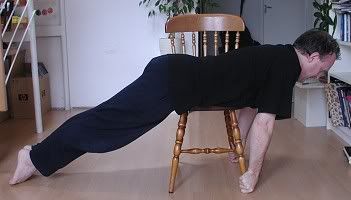
Keeping your trunk and head as parallel to the ground as possible, raise your legs as slowly as you can while you inhale, until your legs are parallel to the ground, like so:
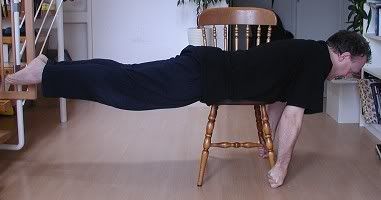 Then slowly let your legs back down to the floor as you exhale (still holding them out straight), until your toes touch the floor.
I recommend doing as many repetitions of this exercise as you do of the five "rites", so that your lower back gets as strong as your abdomen and chest.
Even if you don't do the "Tibetans", it might be a good idea to start doing this exercise if you spend lots of time staring at computer screens. Like you're doing at this very moment.
October 29, 2007
Goin' to the dogs - interlude
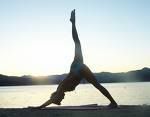 It's been a month since I started doing the "rites", and I'm up to 11 reps of each (though I have done 25 spins since the very start, because I learned that exercise from another source).
The question was raised in the comments whether I am noticing any other effects. Well...
I'm still amazed at how much easier jogging is, and keep in mind that I jog at 5 a.m. It just doesn't seem like the effort it used to be. I have on occasion noticed an improvement of my eyesight, but not dramatic, and not always. I'll keep you posted on that. Lung capacity is definitely up. And, well, I feel better. Getting up in the morning seems to be easier, too. Sleep pattern has changed, though I'd be hard pressed to say exactly how. I tend to wake up about an hour or two before the alarm is set for, and I'm surprised that I feel like I could get up right then.
It was also raised in a comment that some people complain of back pain from doing the Tibetans, and it was suggested that it could be incipient kundalini energy. I wouldn't jump for metaphysical explanations. Fact is that one of the real "burners" in this set is the leg and neck lifts. You end up strengthening your abdominal muscles way out of proportion to your lower back muscles. Your average sedentary contemporary already has weak lower back muscles. Start pumping up the muscles on the front of the trunk and it's bound to cause an imbalance. I compensate with a lower back exercise my chiropractor taught me. I'll keep you posted about how that works out.
I don't want to get ahead of myself in responding to some of the comments, because I plan to discuss the effects of the exercises (physical and metaphysical) in part IV.
October 21, 2007
Goin' to the dogs - Part III
 So The Scribbler posed lots of unanswered questions in the last "dogs" posting. And he's been digging to find the answers. As a matter of fact, he has even employed the formidable talents of Hellibrarian (hereinafter referred to affectionately as "Hell"), to help him dig.
This whole adventure presents much food for thought on the nature and reliability of information in the Internet age. For a while it seemed this posting would end up being a cautionary tale about the dangers of believing what you read on the Internet, and the virtues of checking facts in more "traditional media" such as newspapers, respectable journals, and long-established reference works. You see, I thought I'd found "the truth" in a newspaper article written by a plucky investigative reporter. But after checking her "facts", the twist is that this posting may as well have been entitled "Snarky journalist repeatedly shoots self in foot in major Axel Springer newspaper."
You just wouldn't believe how many websites there are out there dedicated to those five exercises originally called "the rites of rejuvenation" in the Kelder books, but which have eventually come to be known as "The Five Tibetans." Hours of Internet searches established that there are many dozens of them out there. It would be difficult to say exactly how many.
"Five Tibetan" sites mostly fall into two categories: what we'll call fan sites or propaganda sites, and commercial sites.
The propaganda sites are altruistic in spirit. They're put up by people who are so convinced the five "rites" are incredibly beneficial to anyone who will do them these inspired souls feel they must spread the word, and copyright be damned. Anything this important to mankind as a whole, they seem to think, can't possibly be proprietary. Many of the images are- and much of the text is plagiarized. And after browsing through a certain number of them, it becomes apparent that almost all of them reproduce the same diagrams, instructions and background material, and claims of miraculous effects; at times shamelessly cut and paste from one another.
And it also becomes obvious that site after site repeats the same "information" as fact and truth, when it is apparent their authority is another website, which may also have merely parroted another website.
The commercial sites are just as numerous as the propaganda sites. The amazing thing is that they also mostly just repeat the same things you can find on the propaganda sites, but they're using it to sell something (an e-book, a video, a training course). It's pretty amazing that anyone can create supplemental materials for something as simple and easy as five basic exercises to be performed every morning. And they really are basic. But where good health and longevity are being promised, you are bound to find some snake-oil salesmen hanging about.
That brings us to the article I mentioned earlier. The German version of the Wikipedia article on The Five Tibetans lists a link to a 1999 newspaper article that appeared in Die Welt, entitled "Suche nach dem Buch aus dem Nichts" (translation: Search for the book out of nowhere), by Susanna Schwager (article: part I, part II).
From the very first word of Ms Schwager's article, you can see that her viewpoint goes far beyond healthy skepticism. She has a chip on her shoulder. Admittedly, some of her targets are deserving. However one feels about the efficacy of the exercises themselves (she clearly doubts it), the publishing and promotional phenomenon that has come in the book's wake brings new meaning to the word exploitation. She takes Scherz-Verlag, the publisher of the German translation, to task for publishing a children's Tibetans, and a Five Tibetans cookbook for gourmets. But beyond the excesses of the Scherz-Verlag, among the exploiters of the phenomenon the real topper is the training course to become a "certified" teacher of the Five Tibetans for (hold your breath!) 700 Euros. Certified teacher of something anyone can learn in five minutes?
But Ms Schwager's venom is not just for these money changers in the temple, she's out to ridicule anything she perceives as New Age-y, and she's going to start by proving the book is a fraud. She goes to the Zurich Central library with the hypothesis that the book was all an invention of some clever conman in 1985, who falsely claimed to have found a miraculous book published earlier in the 20th century. She and the reference librarian dug (in real hardbound references) to find the 1939 and 1947 editions of this book.
They started with the National Union Catalogue of the Library of Congress. They could find neither a Peter Kelder nor a book called The Eye of Revelation up to 1975. They also looked in the bibliography of France's Bibliotheque Nationale. No dice. When the journalist asked the chief librarian, a Dr. Kohler, what it meant if you can't find a book in any bibliography, he answered, "It always means something isn't quite right (Etwas stimmt nicht). It's a very strong indication that the book was never published. Naturally there are rare cases in which a book just wasn't registered (in the bibliographies), but every book resurfaces sooner or later, especially if there's a new edition." The journalist reports that Dr. Kohler took an interest in the case and did his own research. After two days he gave up. He said he couldn't even find it in esoteric collections, which usually don't have any gaps in them. Nor could he find either Harry R. Gardener or the Midday Press in old listings of publishers. The first record of the book is the 1985 edition by Harbor Press.
By the end of the article, Schwager asserts: there was no Peter Kelder; there was no Colonel, there was no 1939 edition, and no expanded 1947 edition (on which the 1985 edition claims to be based), and the was no Mid-Day Press. The whole thing was an invented con. She also pokes fun at the idea that the 1945 edition was "lost" until 1985.
After reading this, The Scribbler was itching to publish this information for the first time in the English-speaking world, but then I thought perhaps he should do a bit of fact checking himself before relating data from a single source as fact. It's a good thing he did.
Shortly after contacting Hell, she said she found evidence that there really had been a Mid-Day Press in Los Angeles, because she found other books published by them. And then she found (why didn't I think of looking there?) a rare book seller on e-Bay -- Jerry's Rare Books -- selling what he purports to be the only exisiting copy of a 1946 edition of Peter Kelder's The Eye of Revelation.
Here's where the story get real juicy! If you look at the e-Bay offering, you'll see that he's asking (hold your breath again!) $97,500. He doesn't intend to sell it to the average punter, though, he's looking to sell it to an ambitious publisher! In the description, he says:
"As far as is known for certain, this is the only surviving copy of the 1946 edition of the Eye of Revelation! The first four sections of the 1946 edition are largely similar to the 1939 edition; however, section five is entirely new and contains information about:The pictures in his offering (pictures: 1, 2, 3) seem to be convincing evidence of it's authenticity. But I'd still take a documents expert and a lawyer with me before I coughed up $97,500!
* Tibetan Mind Magic
* Mantrams
* The Magic Quality of "Aum"
* and more.
The 1939 editions of the Eye of Revelation have earned millions for their publishers. This 1946 edition can do the same for whomever purchases it. It has been long, long sought after and--with the new, authentic, information--has every chance to outsell any previous edition many times over."

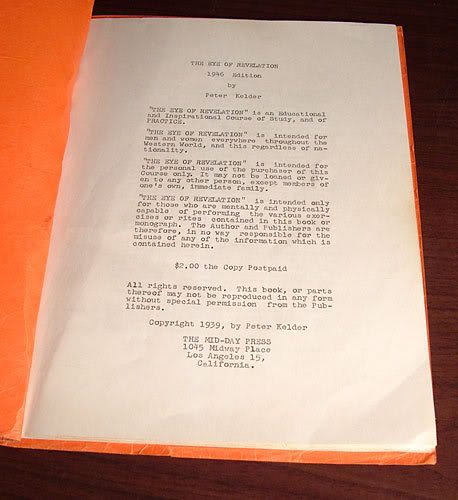
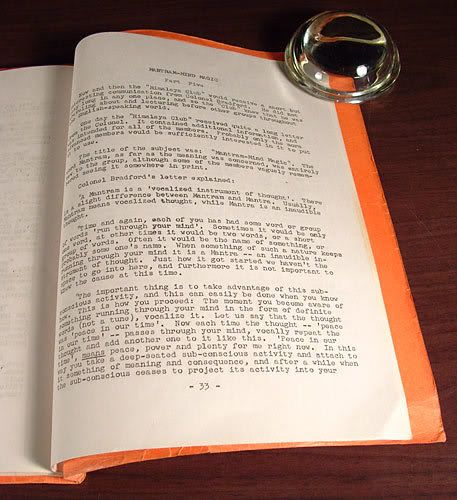
He also mentions that the only known copy of the 1939 original is in the New York City Public Library. That was pretty easy to verify.
So, the very premise of the article in die Welt is in error. Ironically, it took Internet resources to check the facts from a traditional medium (a respected newspaper) which is supposed to be more reliable due to the presence of professional journalists and editors. And her facts came from what should be considered a reliable source: a senior librarian at a well-established major library.
But we still don't know who Peter Kelder was, who the English Colonel was, where these exercises come from, or how they really work (or do they?).
All of that is yet to come in "Dogs" - Part IV.
October 10, 2007
Goin' to the dogs - Part II
 What do Carlos Castaneda's The Teachings of Don Juan, the Golden Dawn's Cipher Manuscripts, and Peter Kelder's The Ancient Secret of the Fountain of Youth (the book on which the "Five Tibetans" phenomenon is based) have in common? They have all had a major impact on the lives of many people, and they have all been attacked by their detractors -- not without reason -- as being frauds.
Yours Truly has been wandering the highways and byways of the Internet, whacking around in the underbrush with several search engines, and he has discovered some interesting things. Interesting, indeed! All is not as it seems! Are you surprised?
Who was Peter Kelder?
What were the mysterious circumstances of "his" book's publication in 1939? The revision in 1947? 1975? The "updated" version of 1985?
Where the heck do these exercises actually come from?
All these questions will be explored in "Goin' to the dogs - Part III." Coming soon.
(Note: I am, however, still faithfully doing the exercises every morning. I'm up to nine reps of each rite every morning. And feeling great!)
October 3, 2007
Goin' to the dogs, Tibetan style
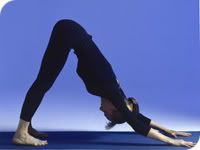
Anyone who knows me to any extent, knows that I get up obscenely early every morning (4:30am) and engage in morning yoga. I call it yoga, because it's too complicated to tell people that it's actually a combination of exercises I've assembled over the last twenty-odd years from the different systems I've learned. My routine has continuously changed during that time, and contains elements of aikido, t'ai chi, chi kung, and hatha yoga.
It all started when I was a fanatical aikidoist in my twenties, and started each day with bokken (wooden sword) practice. I always had in mind that my routine, whatever it consisted of at any given time period of my life, was a spiritual discipline, and not just a physical workout (though my aiki weapons routines used to make me sweat very nicely), which meant that the last part of the routine was always meditation.
As life got more complex (read: having to earn a living and nurse literary ambitions) and commitments increased (read: wife and children), I always strove to create the "ultimate" series that was relatively brief, still hit most of the muscles and joints in the body, and prepared the mind for meditation.
In August, while attending the AMORC World Convention in Berlin, I roomed with a member from Hungary. Every morning, he did a short series of five exercises. What got my attention was that they started with an exercise consisting of holding one's arms out, palms down, and spinning clockwise. I was already doing this exercise as part of my morning routine, but I'd picked it up from a book by Joseph Weed that had been out of print since the 1970s; a source I thought was pretty obscure. He showed me a Hungarian translation of the book Ancient Secret of the Fountain of Youth by Peter Kelder. He offered to loan it to me, but since I don't like reading English books in foreign languages, and since I felt I already had "my" routine, I politely turned him down. But I was really intrigued that the spinning exercise was the same as the one in the Weed book, although Weed said it was part of the training of an ancient Greek seeress. (I think the Weed thing is material for a future posting).
So a little over a week ago, I was researching something on the Internet, when I started getting hits for The Five Tibetan Rites, including this video.
Have you ever considered how that element of randomness to Internet searches makes the Internet kind of "oracular"? I mean: I don't know about you, but I seem to often "stumble across" things just at the very moment I need them in my life. Well, this Five Tibetans thing was popping up pretty often, so I decided to go for it. So now I've incorporated them into my morning routine. More than that: they've become the basis of my morning routine. I use a little chi kung twist to warm up my spine, and an aikido weight shifting exercise to get the circulation going in my legs and arms, but the heart of the workout is The Five Tibetans.
It's only been five days, and I can already feel things happening in my body. Yesterday and the day before I kept getting these warm sensations in my lower back like someone was holding a hot water bottle up against it. Yesterday I used it as the warm up for my every-third-day jogging session instead of my usual warm ups. I was bouncing down the sidewalk like a rubber ball the whole way (yee-haa!). Best run I've had in months!
There are all kinds of theories about why it works, and I have some thoughts on that, but I need to get to bed so I can get up and do my exercises in the morning. ;-)
Maybe I'll have to blog about this more later.
It all started when I was a fanatical aikidoist in my twenties, and started each day with bokken (wooden sword) practice. I always had in mind that my routine, whatever it consisted of at any given time period of my life, was a spiritual discipline, and not just a physical workout (though my aiki weapons routines used to make me sweat very nicely), which meant that the last part of the routine was always meditation.
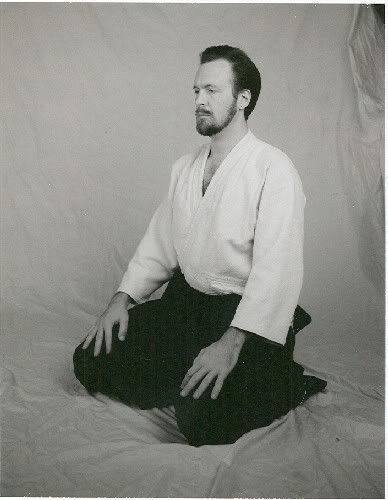
As life got more complex (read: having to earn a living and nurse literary ambitions) and commitments increased (read: wife and children), I always strove to create the "ultimate" series that was relatively brief, still hit most of the muscles and joints in the body, and prepared the mind for meditation.
In August, while attending the AMORC World Convention in Berlin, I roomed with a member from Hungary. Every morning, he did a short series of five exercises. What got my attention was that they started with an exercise consisting of holding one's arms out, palms down, and spinning clockwise. I was already doing this exercise as part of my morning routine, but I'd picked it up from a book by Joseph Weed that had been out of print since the 1970s; a source I thought was pretty obscure. He showed me a Hungarian translation of the book Ancient Secret of the Fountain of Youth by Peter Kelder. He offered to loan it to me, but since I don't like reading English books in foreign languages, and since I felt I already had "my" routine, I politely turned him down. But I was really intrigued that the spinning exercise was the same as the one in the Weed book, although Weed said it was part of the training of an ancient Greek seeress. (I think the Weed thing is material for a future posting).
So a little over a week ago, I was researching something on the Internet, when I started getting hits for The Five Tibetan Rites, including this video.
Have you ever considered how that element of randomness to Internet searches makes the Internet kind of "oracular"? I mean: I don't know about you, but I seem to often "stumble across" things just at the very moment I need them in my life. Well, this Five Tibetans thing was popping up pretty often, so I decided to go for it. So now I've incorporated them into my morning routine. More than that: they've become the basis of my morning routine. I use a little chi kung twist to warm up my spine, and an aikido weight shifting exercise to get the circulation going in my legs and arms, but the heart of the workout is The Five Tibetans.
It's only been five days, and I can already feel things happening in my body. Yesterday and the day before I kept getting these warm sensations in my lower back like someone was holding a hot water bottle up against it. Yesterday I used it as the warm up for my every-third-day jogging session instead of my usual warm ups. I was bouncing down the sidewalk like a rubber ball the whole way (yee-haa!). Best run I've had in months!
There are all kinds of theories about why it works, and I have some thoughts on that, but I need to get to bed so I can get up and do my exercises in the morning. ;-)
Maybe I'll have to blog about this more later.
Subscribe to:
Posts (Atom)