Showing posts with label blogging. Show all posts

September 3, 2008

Getting Coaxed Out of Blog Sabbatical


Well, folks, I still don't feel like addressing the most immediate issues in my life, and I still don't feel comfortable blithely talking about other things either.

But there's a voice out there in Blogdom that won't let me sink into complete silence. Bless her.

In a recent posting, Hellibrarian placed me among the ranks of people she wished to thank for various things, referring to me as her "blogger conscience." I decided to talk a little about the history of our writing relationship, but when I sat down to the computer, I quickly checked my feed reader and discovered that she'd (quite synchronistically) already alluded to our early "writing buddy" days in her posting today. And she claims to not believe in "psychic dialoging."

Hell and I met back in the autumn of 1992, when Budapest was still "The Wild East". We were both on the founding staff of The Budapest Sun, and shared one of the most amazing experiences a beginning writer could ever have. We got paid peanuts, and had more fun than most people can possibly even imagine. There was something about the times and about the mix of characters who worked at that paper that made the experience nothing less than magical: every day we wondered what would happen next.

We both moved onto other jobs (her with Where Magazine, me with The Hungarian Press Agency) but we continued to support each others' creative endeavors, which can quickly get buried in the day-to-day spade work that makes up ninety-nine-percent of all journalism work.

Hell and I would meet at the Astoria Hotel (pictured on her blog), which has a cafe with the most amazing Art Nouveau interior, and for the longest time had very affordable coffee and pastries. And it was the kind of place where they didn't mind if you hung around for hours. We would get comfortable, order coffee and pastries, shoot the breeze for a while, and then get out the notebooks. We'd choose a topic and (Natalie Goldberg style) decide how long we'd write (anywhere from ten minutes to half an hour). And then we'd just let our pens race across the pages with no inhibitions. No talking. No pausing. Just writing. After the session was over, we'd read our essays to one another.

Ah! Fond memories.

In that spirit, when Hell has lagged in the maintenance of her blog, I've prodded her some, and reminded her that people with the writing bug just can't be happy unless they're doing a certain amount of writing. And now, when I'm lapsing into silence, Helen is there to remind me of the same.

Bless you.

August 27, 2008

Sorry Folks...

... but there are some things I just don't want to blog about, at least not while I'm in the middle of them. I'm going through some heavy times -- my life filled with life-and-death issues -- and I don't want to write about them in a superficial overly emotional fashion. When I was younger, I knew that writing about things when they were fresh -- sometimes even with pen in hand while they were happening -- gave things serious edginess. But now I realize that's sensation, and not an honest way to search for a deeper kind of truth. I don't want to turn what I'm going through into sensation. And at the same time, I don't want to blithely post about other things, as if everything was hunky dory. My heart wouldn't be in it.

I'll take a page out of The Third Eve's book. She recently wrote an article about something very trying, very demanding, and very emotionally overwhelming that happened to her a year ago. She didn't write about it then. She waited until it settled, and she could make sense of it; until the experience had ripened. It's more meaningful that way.

So I might wait a while to write about these things. That is, if I ever write about them.

July 30, 2008

You Call THAT Summer Reading?

Although four days ago I escaped the urban circus of Budapest for the idyllic peace of a farm house in southeastern Hungary, far, far from TV cables and internet connections and subway trains and all the other features of my harried life (which I love, but gets a bit much after a while), through the miracles of online technology this posting is being published on my appointed publishing day, thereby keeping my promise to grace the world with another dose of my prose every Wednesday. (Note to self: I should suggest to Google that they develop an application called iStiff, which sends an indistinguishable virtual image of a nine-to-five employee to the office through the internet every weekday morning, while the real employee stays home and putters around the house, blogs, meets friends at cafes, etc. Sounds like the Next Big Thing, huh?)

As this digital missive is being released into cyberspace, its flesh-and-blood author will have already spent days breathing fresh air, taking walks in the woods, watching his kids play with farm animals, cooking meals for ten (we'll be there with another family with children), watching the stars in a clear sky free of city lights, and... READING!

Now, being a corporate editor, reading on vacation is a bit like a busman's holiday, but as any professional reader (or college student) will tell you, there's a world of difference between reading what you have to, and reading what you want to.

Admittedly, being on vacation with that many children doesn't really allow for that much reading time, which is why I have to make every minute of it count. So... no mental-chewing-gum potboilers for me. Why waste that quality time away from the frenetic life, while my blood pressure is down and my brain waves smoothed out to gentle curves? No, I'm going to bring along two books that are definitely not what most folks would consider light beach reading.

The first is a novel. I don't read many novels anymore. First of all, I don't have time for them. I recall when I was younger, being very disdainful of people who say they don't have time to read. But, now I'm in that position. A full-time job, four kids and a commitment to spiritual exercises doesn't leave much time for other things. And the truth is, I do read. But shorter stuff I can squeeze in while commuting or eating lunch: articles on subjects I'm interested in, short stories (especially from my favorite speculative fiction site Strange Horizons). I read chapters from e-books on subjects I'm researching. But novels, no. You have to have long stretches of time to read novels. Reading a three-hundred page novel at a rate of four pages a day is very frustrating.

So, there's this six-hundred-page book I started,...uh,... a year ago on a bus ride to a company outing. I got one or two chapters read on the bus. Then I struggled for a few weeks at three or four pages a day and gave up. Around Christmas I took the time to plow through half of the book, and gave up when vacation was over. At this point I still have 170 pages of Gustav Meyrink's The Angel of the Western Window left.

Many of you will know the name Meyrink as the author of The Golem, but far fewer people know that Meyrink was actually an initiate of the western esoteric tradition, and that he wrote a number of esoterically significant novels. The plot of Angel takes place in two different time periods. One is the lifetime of Dr John Dee (1527-1608), and the other is the lifetime of the first-person narrator, a bachelor gentleman in Vienna in the early twentieth century. We slip into John Dee's time whenever the narrator reads Dee's diaries. I won't spoil the story for you (because you really should read it), but suffice it to say that the interaction between these two times and personalities becomes very bizarre and intricate.

Dr Dee was the Renaissance man's Renaissance man. There's hardly an art or science this man didn't dabble in, if not excel at or pioneer, including magic. And this novel is very much about the magical side of Dee. And the sweep of the novel is incredible: England and Wales, Emperor Rudolf's Prague (including Rudolf himself), Vienna, and more.

I've really worked myself up! I can't wait to get back to it.

The other book I'm taking along is a very thin, but very dense volume by Dr John Dee himself: The Hieroglyphic Monad. I've been wanting to delve into this book for some time now, but just haven't felt the time was right. This is the type of book Georg Kuhlewind would designate a "contemplative book". That means that, unlike a light novel, or an instruction book, or a magazine article, it is meant to be absorbed a few sentences at a time. The prime example of such a book, according to Kuhlewind, is the Gospel of John. One should, he says, read a sentence or two, and then deeply meditate on them to see what they evoke from deeper levels of consciousness. I'm certain this is how the Monad is meant to be read. It is divided up into 24 short theorems, each short enough to read in a few minutes. So, in the afternoons, after lunch has been served and the children are playing in the yard, or in the barn, I plan to drag a comfortable lawn chair out under a tree in the yard, sample a theorem, and then slowly sip my tea and contemplate.

Slowly. Patiently.

July 9, 2008

Announcement: Scribbler Goes Weekly!

That's right folks! The Scribbler had a serious talk with himself and decided a change was needed.

When I started this blog a little over a year ago, I declared that I wasn't really interested in your public diary sort of blog. Not to say that there isn't a call for that kind of blog. Lord knows I even read a few like that. It's a good way to keep up with family and friends who publish them. And just because a blog concentrates on such subject matter doesn't mean it can't be intellectually deep, or aesthetically dazzling.

But that's just not what I was aiming for. I wanted to concentrated on good writing; the sort of thing I used to write when I wrote columns for small newspapers. And, I said this was going to be a philosophical blog, which is still my aim.

To a certain extent, I have succeeded. I've been pleased with some of the essays I've published in this blog, and I've received good feedback. But something was missing. I couldn't put a finger on why it was so difficult for me to motivate myself to publish regularly, unlike my wife, who puts out new postings almost daily (sometimes even more than one a day!), and doesn't seem to ever run out of steam. She's my alphablogger. When she mentions my blog in her blog, my stats go through the roof for a day or two.

I tend to write long. (I can hear some people out there saying, "Tell us something we didn't know!") Years of habit make me think of ideas that take about 800 words to express; columns in other words. And it's just so hard to keep that up all the time when you're a nine-to-six working stiff.

And then it occurred to me: deadlines! I'm a deadline creature! Tell me an article is due on Tuesday at five, and you'll get it in the e-mail on Tuesday at 4:50.

I followed a blog once that published weekly. It was good. I always looked forward to publishing day (I think it was Monday), and his pieces were always worth reading. It worked.

So that's how it's going to work around here now. Starting today, A Touch of Pansophia will publish a posting -- think: column -- every week, and Wednesday will be publishing day. That doesn't mean I won't ever post in between, but Wednesday will be a deadline I commit myself to keep every week. I can already feel my creative juices responding to the deadline pressure.

Later today I'm going to cheat by publishing something I already have in the can. It's Wednesday: time to publish!

January 9, 2008

Back to Business

Well folks! I like Christmas as much as the next guy; probably even more, actually, since being a Waldorf parent has taught me valuable lessons about how to seriously tone down the commercial aspects of the season and to tune into the spiritual dimensions of the "festival of light." I had a great time. Szilvi had a great time. The kids had a great time. But once the noise and indulgence of New Year's Eve has passed, and the tree and decorations are whisked away on Epiphany, I really enjoy the feeling of rolling up the ol' sleeves and getting back to business.

Don't get me wrong. I'm not a workaholic. When I say business, I'm not talking about professional life and what goes on in the office at The Firm (though that's part of it). I'm talking about the business of my life. The day-in day-out task of figuring out what my role is in this world and trying to be an effective player in the story of the human race. That business.

I've been observing how, despite the fact that I've generally become a calmer and more focused individual over time, reality still challenges me with little things like the traffic accident (fender bender) I had four days before Christmas, or the surly clerk I had to interact with at the post office today. There are just moments when I feel really uptight because I'm in a hurry and I have to get too many things done in too short a time and there's something in the back of mind that's bugging me and "Bzzzzzzzzzt!!!" something short-circuits and I yell, or I drop something in the kitchen and shatter it and scatter its contents all over the floor. I reflect on those moments and realize I still have a lot to learn about staying cool under pressure.

I'm much better about things I can prepare for nowadays. I can give a presentation at a meeting with minimal nervousness by meditating and visualizing. I can often recognize bad states of mind coming on and head them off in time. It's those sudden, unexpected challenges to my cool that still trip me up.

With that in mind, I'd like to give y'all a gander at a nice essay I read the other day. It's about maintaining stability in an unstable world. It was written by a raja yoga teacher who uploads material to ScribD. I have to admit that part of the reason I'm doing this is just to see what one of these things looks like on a blog when you embed it.

But I've been letting this stagnate long enough over the holidays. It's time to get back to business.

Enjoy!

November 15, 2007

I wasn't expecting THAT!


If imitation is the greatest form of flattery, then parodying the hell out of someone must be the greatest form of... love? I hope so.

Once I got over the "Oh my God!" reaction, I couldn't stop chuckling about this posting on a friend's blog.

I consider myself well roasted, or should I say toasted?


November 4, 2007

Puttin' on the feed bag

(RSS feed, that is)

There are times I can be downright geeky. For several years, I was the one people came to at the Hungarian Press Agency's Econews when they had a problem with Microsoft Windows. But there are times I can be nearly Luddite in my resistance to adopting new technologies, especially if I suspect there's some evil, hidden capitalist agenda behind it. Only fools try something just because it's new.

And that's the way it was between me and RSS technology. For years now I've seen links on pages offering "feeds" of various content. "Sure," I thought, "like I need more stuff cluttering up my life. It probably involves getting lots of spam and getting placed on lists of idiots who do things like send in Reader's Digest contest entries."

I also knew it had something to do with what, in the golden era of Netscape (long ago, in a galaxy far, far away...) was referred to as "push technology." Wow, was that ever a flop. Another idea the world and the Scribbler just weren't ready for. "No thank you," I proudly said, "I can go looking for the stuff I want. I don't need to have it delivered to me."

And then I became a blogger.

When you configure your blog, among the settings are the settings for your feeds. I got to wondering what this was all about. Then I noticed the links on my blog for feeds. Hmmm. How does this work? I kept wondering what a reader would see and experience if they subscribed to a feed of my blog. For that matter, if it would even work.

And besides that, part of the blogging game (and I'm sure I'm not telling most of you anything new) involves reading other blogs. It makes sense. Novelists read novels. Journalists read newpapers and magazines, and bloggers read other blogs. It's just part of learning how to do it. And, of course, one needs to understand that blogging is a social activity, not just a solitary craft.

The long and the short of it: bloggers read (or should read) blogs.

So I went to a friend's blog and subscribed. Due to the fact that I've been a Google person ever since I got my first invitation to G-mail three years ago (I'm a Google whore: I use G-mail, Blogger, Page Creator, Analytics, Google Documents, Google Talk...), setting up the feed with Google Reader was absurdly easy. Hmmm. The research I'd read about RSS said it can save time for people who regularly check certain websites to see if there's new information. Hmmm.

So I subscribed to all the blogs I read. And you know what? I, er, have to admit. It's saving me time. I just open my feed reader, and it shows me which blogs have new postings, and I can read them right there. If I want to comment, one keystroke takes me to their blog. Amazing. No more clicking around on links and waiting for blogs to load, only to find out there's nothing new.

Now I still think you'd have to be crazy to subscribe to a feed of something like CNN. Your reader would be full-to-groaning with new stuff all the time. But for the conscientious blogger, I have to admit this is a good tool.

Not to say that it isn't a good thing to be a bit Luddite sometimes.

October 21, 2007

Goin' to the dogs - Part III

So The Scribbler posed lots of unanswered questions in the last "dogs" posting. And he's been digging to find the answers. As a matter of fact, he has even employed the formidable talents of Hellibrarian (hereinafter referred to affectionately as "Hell"), to help him dig.

This whole adventure presents much food for thought on the nature and reliability of information in the Internet age. For a while it seemed this posting would end up being a cautionary tale about the dangers of believing what you read on the Internet, and the virtues of checking facts in more "traditional media" such as newspapers, respectable journals, and long-established reference works. You see, I thought I'd found "the truth" in a newspaper article written by a plucky investigative reporter. But after checking her "facts", the twist is that this posting may as well have been entitled "Snarky journalist repeatedly shoots self in foot in major Axel Springer newspaper."

You just wouldn't believe how many websites there are out there dedicated to those five exercises originally called "the rites of rejuvenation" in the Kelder books, but which have eventually come to be known as "The Five Tibetans." Hours of Internet searches established that there are many dozens of them out there. It would be difficult to say exactly how many.

"Five Tibetan" sites mostly fall into two categories: what we'll call fan sites or propaganda sites, and commercial sites.

The propaganda sites are altruistic in spirit. They're put up by people who are so convinced the five "rites" are incredibly beneficial to anyone who will do them these inspired souls feel they must spread the word, and copyright be damned. Anything this important to mankind as a whole, they seem to think, can't possibly be proprietary. Many of the images are- and much of the text is plagiarized. And after browsing through a certain number of them, it becomes apparent that almost all of them reproduce the same diagrams, instructions and background material, and claims of miraculous effects; at times shamelessly cut and paste from one another.

And it also becomes obvious that site after site repeats the same "information" as fact and truth, when it is apparent their authority is another website, which may also have merely parroted another website.

The commercial sites are just as numerous as the propaganda sites. The amazing thing is that they also mostly just repeat the same things you can find on the propaganda sites, but they're using it to sell something (an e-book, a video, a training course). It's pretty amazing that anyone can create supplemental materials for something as simple and easy as five basic exercises to be performed every morning. And they really are basic. But where good health and longevity are being promised, you are bound to find some snake-oil salesmen hanging about.

That brings us to the article I mentioned earlier. The German version of the Wikipedia article on The Five Tibetans lists a link to a 1999 newspaper article that appeared in Die Welt, entitled "Suche nach dem Buch aus dem Nichts" (translation: Search for the book out of nowhere), by Susanna Schwager (article: part I, part II).

From the very first word of Ms Schwager's article, you can see that her viewpoint goes far beyond healthy skepticism. She has a chip on her shoulder. Admittedly, some of her targets are deserving. However one feels about the efficacy of the exercises themselves (she clearly doubts it), the publishing and promotional phenomenon that has come in the book's wake brings new meaning to the word exploitation. She takes Scherz-Verlag, the publisher of the German translation, to task for publishing a children's Tibetans, and a Five Tibetans cookbook for gourmets. But beyond the excesses of the Scherz-Verlag, among the exploiters of the phenomenon the real topper is the training course to become a "certified" teacher of the Five Tibetans for (hold your breath!) 700 Euros. Certified teacher of something anyone can learn in five minutes?

But Ms Schwager's venom is not just for these money changers in the temple, she's out to ridicule anything she perceives as New Age-y, and she's going to start by proving the book is a fraud. She goes to the Zurich Central library with the hypothesis that the book was all an invention of some clever conman in 1985, who falsely claimed to have found a miraculous book published earlier in the 20th century. She and the reference librarian dug (in real hardbound references) to find the 1939 and 1947 editions of this book.

They started with the National Union Catalogue of the Library of Congress. They could find neither a Peter Kelder nor a book called The Eye of Revelation up to 1975. They also looked in the bibliography of France's Bibliotheque Nationale. No dice. When the journalist asked the chief librarian, a Dr. Kohler, what it meant if you can't find a book in any bibliography, he answered, "It always means something isn't quite right (Etwas stimmt nicht). It's a very strong indication that the book was never published. Naturally there are rare cases in which a book just wasn't registered (in the bibliographies), but every book resurfaces sooner or later, especially if there's a new edition." The journalist reports that Dr. Kohler took an interest in the case and did his own research. After two days he gave up. He said he couldn't even find it in esoteric collections, which usually don't have any gaps in them. Nor could he find either Harry R. Gardener or the Midday Press in old listings of publishers. The first record of the book is the 1985 edition by Harbor Press.

By the end of the article, Schwager asserts: there was no Peter Kelder; there was no Colonel, there was no 1939 edition, and no expanded 1947 edition (on which the 1985 edition claims to be based), and the was no Mid-Day Press. The whole thing was an invented con. She also pokes fun at the idea that the 1945 edition was "lost" until 1985.

After reading this, The Scribbler was itching to publish this information for the first time in the English-speaking world, but then I thought perhaps he should do a bit of fact checking himself before relating data from a single source as fact. It's a good thing he did.

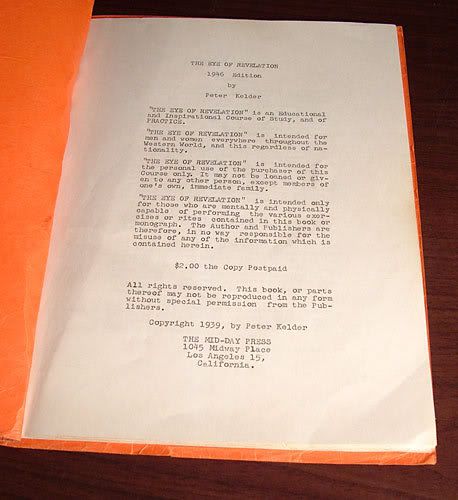
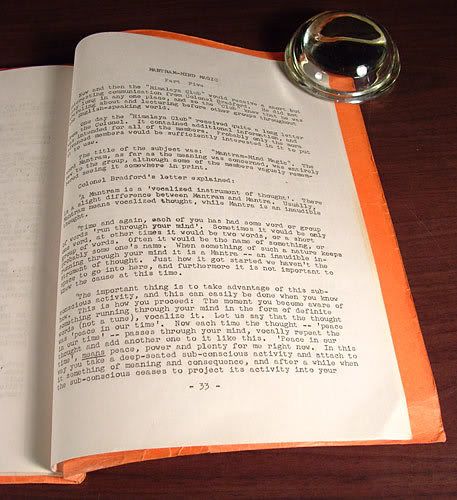
Shortly after contacting Hell, she said she found evidence that there really had been a Mid-Day Press in Los Angeles, because she found other books published by them. And then she found (why didn't I think of looking there?) a rare book seller on e-Bay -- Jerry's Rare Books -- selling what he purports to be the only exisiting copy of a 1946 edition of Peter Kelder's The Eye of Revelation.

Here's where the story get real juicy! If you look at the e-Bay offering, you'll see that he's asking (hold your breath again!) $97,500. He doesn't intend to sell it to the average punter, though, he's looking to sell it to an ambitious publisher! In the description, he says:
"As far as is known for certain, this is the only surviving copy of the 1946 edition of the Eye of Revelation! The first four sections of the 1946 edition are largely similar to the 1939 edition; however, section five is entirely new and contains information about:

* Tibetan Mind Magic
* Mantrams
* The Magic Quality of "Aum"
* and more.

The 1939 editions of the Eye of Revelation have earned millions for their publishers. This 1946 edition can do the same for whomever purchases it. It has been long, long sought after and--with the new, authentic, information--has every chance to outsell any previous edition many times over."
The pictures in his offering (pictures: 1, 2, 3) seem to be convincing evidence of it's authenticity. But I'd still take a documents expert and a lawyer with me before I coughed up $97,500!

He also mentions that the only known copy of the 1939 original is in the New York City Public Library. That was pretty easy to verify.

So, the very premise of the article in die Welt is in error. Ironically, it took Internet resources to check the facts from a traditional medium (a respected newspaper) which is supposed to be more reliable due to the presence of professional journalists and editors. And her facts came from what should be considered a reliable source: a senior librarian at a well-established major library.

But we still don't know who Peter Kelder was, who the English Colonel was, where these exercises come from, or how they really work (or do they?).

All of that is yet to come in "Dogs" - Part IV.
October 16, 2007

Moving in the old furniture

The Firm is in a state-of-the-art office building. With identical data outlet sockets in every room, modular office furniture, and an efficient office administration department supplied with plenty of hand trucks and burly workers, they can move a person's working space (including desk, files, computer, lamps, cabinets) from one room to another inside an hour. I recall the dizzy feeling of working in one room at nine in the morning, and being moved, and working somewhere else by eleven; phone working, computer on the network, cabinets and files set up. I'd never worked for a huge multi-national company before I came to The Firm, so I was unprepared for the psychological effects of being moved four times within my first year. At first I put up a fight and tried to ultimately personalize my space with art prints and interesting objects. Then each time I moved it took longer to unpack the boxes and get out "aesthetic" stuff. I've adopted a much plainer style of decorating my office.

Same goes for staking claim to a patch of cyberspace. I recall all the effort I went to creating my first websites: writing them in html, uploading them to my ISP's server with an FTP client, rewriting and uploading every time I wanted to make a change. Things are so much easier nowadays with Google and other on-line hosts. And there are other reasons I created pages. I was a very hands-on forum administrator for a few years, and I created pages of references for the members. And each time I changed ISPs or had to abandon a server for some reason, it would take a long time to motivate myself to upload my old pages and get them to work right again.

Blogging is a new medium to me. It took me some time to warm up to it. There were a few weeks I didn't think I wanted to keep doing it. There's a feeling associated with it that very much reminds me of the pressure of writing a weekly newspaper column. But there's a positive side to that pressure (which I realize nobody else but me is putting on myself), and that's the impetus to create.

So... I've decided I'm gonna be in this space for a while. I may as well unpack my boxes and decorate a little. You'll notice a new sidebar on the right containing links to some of the old html pages I mentioned above.

The first one, Resources for Dreamers, I created for a short-lived dreamwork forum I ran two years back. There's good stuff on that list. It took some digging on the Internet to find a lot of it. I actually have found more since I made that list, so I plan to update it sometime soon. Stay tuned!

The next one down, The Secret Archives, is one of the first websites I ever created, back in 2000. It's corny, and has that retro look to it. But I've decided to leave it as it is. It's a repository of my writing from the 1990s.

And the third link, Mystical and Occult Libraries and Text Archives, was something I created for a mysticism forum I moderated for several years. Those links also took some digging to collect. I've also found more to add to this list since I created it, so keep your eyes open for an update of that, too.

Phew! Unpacking and setting up house is hard work. But before I call it a day and crack open a beer, could somebody help me get this chest of drawers over to that corner over there?

October 10, 2007

Goin' to the dogs - Part II

What do Carlos Castaneda's The Teachings of Don Juan, the Golden Dawn's Cipher Manuscripts, and Peter Kelder's The Ancient Secret of the Fountain of Youth (the book on which the "Five Tibetans" phenomenon is based) have in common? They have all had a major impact on the lives of many people, and they have all been attacked by their detractors -- not without reason -- as being frauds.

Yours Truly has been wandering the highways and byways of the Internet, whacking around in the underbrush with several search engines, and he has discovered some interesting things. Interesting, indeed! All is not as it seems! Are you surprised?

Who was Peter Kelder?

What were the mysterious circumstances of "his" book's publication in 1939? The revision in 1947? 1975? The "updated" version of 1985?

Where the heck do these exercises actually come from?

All these questions will be explored in "Goin' to the dogs - Part III." Coming soon.

(Note: I am, however, still faithfully doing the exercises every morning. I'm up to nine reps of each rite every morning. And feeling great!)

July 10, 2007

The True, the Beautiful and the Good

So, we've established that I have the itch to get serious about writing again. And we've established that I'm a bit leery of the confessional nature of blogs, having learned what it's like to talk about your life in even a very small general-circulation publication.

But if not confession, or criticism, or journalism, what do I write?

Philosophy.

This isn't a spontaneous decision. We have to go back several years to 2003, when I decided to seriously take up the study of Rosicrucianism again. One of the odd effects of that decision was that as I became more and more immersed in the study and practice of mysticism, the less I was interested in the literary pursuits (reading and writing fiction) that had been the mainstay of my intellectual life for two decades. "But why," I asked myself, "have I spent so much of my life perfecting my ability to express myself in words?" You see, I believe that life is a series of lessons, and that the path one follows in life eventually leads somewhere, although we are not necessarily conscious of that path, and only recognise the inherent pattern (if we're lucky) in retrospect.

So, if I've cultivated the craft of the wordsmith, and I no longer have the fire in my gut to become the next J. D Salinger (or even Tom Robbins), then what do I write?

The urge to dip into philosophical writing hit me nearly a decade ago, and I produced a series of aphoristic essays called The Book of Acquired Wisdom. I enjoyed the exercise, and it whet my appetite for more such explorations.

So that will, loosely defined, be my focus in this blog. I shall explore philosophy.

To start off on solid footing, I suppose I should make clear what I mean by the word philosophy. I'll state unambiguously, that I am not a "professional" philosopher. I've read some in the pre-Socratics, and I've read some Plato. I've puzzled over how Aristotle was a logical conclusion to Plato. I've read Lucretius and Marcus Aurelius. I've pondered over Thoreau, and I've even dabbled in a bit of Nietzsche. But I know little to nothing about most of the modern European philosophers (you know: Descartes, Voltaire, Hobbes, Locke, Rousseau, Fichte, Shopenhauer, Hegel, etc.), beyond the odd quote here, the quick synopsis there.

But I don't think that's any reason why I can't philosophize. Because to me, philosophy is exactly what the word originally meant in Greek: a love of wisdom. Wisdom can only be found one way. Wisdom arises in the heart after one has honestly reflected on one's experience. External experience and internal experience. Experience with love, friendship and family. Experience with trying to make a living and pursue a calling. Experience with study and exchanging ideas with fellow scholars. Experience at trying to understand the workings of the physical world, and mastering the technologies our race has created to exploit it. Experience with living in this mortal body, and feeling and watching it change with the passage of time. Experience with trying to do good in the world, and to contribute to the greater good. Experience with the joys and difficulties of living in human society, in which we must endure the ignorance of our fellow man as often as we have the pleasure of our contemporaries' refinements. If you truly and carefully reflect on these things, wisdom will arise in your heart. You will begin to discern what is the True, what is the Beautiful, and what is the Good. And by some small measure, you may call yourself a philosopher.

July 8, 2007

A Long Time Coming

I've been resisting this for a long time. People have been telling me for years, "You're a writer. So you should be writing a blog." Well, yes, I can appreciate that this is the medium du jour nowadays for the written word. I realize this is the publishing venue that puts people out in the public eye now. And I do want to write material for publication (it's been year since I've done it), but... but...

Let's go back to the "old days" (the 1980s) when most of my writing was either scribbling my journal with a pen in a notebook, or composing letters on a typewriter. I did this for years before I ever got ambitious enough to write anything for publication. And at first what got published was very infrequent.

Then came the early nineties, and I was writing on a hand-me-down Zenith computer (double floppy drive!), and the majority of my writing was a weekly book review column for The Budapest Sun. It was an interesting experience having a weekly column in a paper with 20,000 readers. For two years most everyone in the expatriate community knew my name, and I even had the occasion to hear myself talked about at parties. People would stop me and comment on my latest column, telling me if they disagreed with my opinion, or found fault with my arguments, and occasionally praising a job well done.

I observed that one sits down to the keyboard with a distinctly different state of mind when one is just going to noodle around in one's journal, and when one is preparing to write a column. When I wrote the column, there were 20,000 invisible people in the room with me, and it had a profound effect on the way I wrote. Very profound. This was the most important lesson in voice I've ever had: how you write depends on who you think is reading it.

I also observed that the desire to be what one nowadays calls "edgy" made me wax confessional. One colleague of mine at the press agency said he'd never dare write about such personal things as I did, knowing it would be read by so many people. I said that was because he wasn't a writer. In the meantime, I feel like I've become much more private than I was in my early thirties. I'm not so much into the confessional anymore. My wife has been writing a blog for about a year and a half. It's a moderately popular blog, with regular readership of about 200, which is pretty good for a blog written in Hungarian. Our children and I get mentioned regularly. I don't even have to do confessional for myself anymore.

Since my days at The Sun, on the professional level I have written a few freelance articles and columns, but have mostly retired to the business of copy editing (ten years at the Hungarian Press Agency MTI) and in-house corporate editing (name withheld to protect against the litigious). And I've written a handful of short stories (got one published!). Before our home and my life got filled up with a bunch of kids, and before I got a full-time corporate job, I wrote a daily journal for several years. That was my second major lesson in voice: a very different sort of writing comes out when you are writing strictly for yourself.

There's one more consideration. My priorities have changed drastically. My ambitions were very literary when I used to write alot. I took a break from writing for several years, and in the meantime, the focus of my life has become spiritual again. Although I feel the compulsion to write -- and even publish -- again, much of my life centers around internal experiences, and much of what I occupy myself with is esoteric in nature. I'm a bit reluctant to write about some of this stuff. It was one thing to be confessional about more mundane sides of my life, but it's something altogether different to start getting loose-lipped about mysticism. We'll see.

And the other thing I can't get over is what I regard as the ultimate question regarding blogging and bloggers. What makes me think anyone cares?

Okay. For better or worse, I've taken the first step. I have become a blogger. God save my soul.

So, I come late to this medium. And I'm not sure how I feel about it.