October 21, 2007

Goin' to the dogs - Part III

So The Scribbler posed lots of unanswered questions in the last "dogs" posting. And he's been digging to find the answers. As a matter of fact, he has even employed the formidable talents of Hellibrarian (hereinafter referred to affectionately as "Hell"), to help him dig.

This whole adventure presents much food for thought on the nature and reliability of information in the Internet age. For a while it seemed this posting would end up being a cautionary tale about the dangers of believing what you read on the Internet, and the virtues of checking facts in more "traditional media" such as newspapers, respectable journals, and long-established reference works. You see, I thought I'd found "the truth" in a newspaper article written by a plucky investigative reporter. But after checking her "facts", the twist is that this posting may as well have been entitled "Snarky journalist repeatedly shoots self in foot in major Axel Springer newspaper."

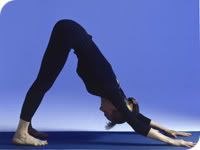
You just wouldn't believe how many websites there are out there dedicated to those five exercises originally called "the rites of rejuvenation" in the Kelder books, but which have eventually come to be known as "The Five Tibetans." Hours of Internet searches established that there are many dozens of them out there. It would be difficult to say exactly how many.

"Five Tibetan" sites mostly fall into two categories: what we'll call fan sites or propaganda sites, and commercial sites.

The propaganda sites are altruistic in spirit. They're put up by people who are so convinced the five "rites" are incredibly beneficial to anyone who will do them these inspired souls feel they must spread the word, and copyright be damned. Anything this important to mankind as a whole, they seem to think, can't possibly be proprietary. Many of the images are- and much of the text is plagiarized. And after browsing through a certain number of them, it becomes apparent that almost all of them reproduce the same diagrams, instructions and background material, and claims of miraculous effects; at times shamelessly cut and paste from one another.

And it also becomes obvious that site after site repeats the same "information" as fact and truth, when it is apparent their authority is another website, which may also have merely parroted another website.

The commercial sites are just as numerous as the propaganda sites. The amazing thing is that they also mostly just repeat the same things you can find on the propaganda sites, but they're using it to sell something (an e-book, a video, a training course). It's pretty amazing that anyone can create supplemental materials for something as simple and easy as five basic exercises to be performed every morning. And they really are basic. But where good health and longevity are being promised, you are bound to find some snake-oil salesmen hanging about.

That brings us to the article I mentioned earlier. The German version of the Wikipedia article on The Five Tibetans lists a link to a 1999 newspaper article that appeared in Die Welt, entitled "Suche nach dem Buch aus dem Nichts" (translation: Search for the book out of nowhere), by Susanna Schwager (article: part I, part II).

From the very first word of Ms Schwager's article, you can see that her viewpoint goes far beyond healthy skepticism. She has a chip on her shoulder. Admittedly, some of her targets are deserving. However one feels about the efficacy of the exercises themselves (she clearly doubts it), the publishing and promotional phenomenon that has come in the book's wake brings new meaning to the word exploitation. She takes Scherz-Verlag, the publisher of the German translation, to task for publishing a children's Tibetans, and a Five Tibetans cookbook for gourmets. But beyond the excesses of the Scherz-Verlag, among the exploiters of the phenomenon the real topper is the training course to become a "certified" teacher of the Five Tibetans for (hold your breath!) 700 Euros. Certified teacher of something anyone can learn in five minutes?

But Ms Schwager's venom is not just for these money changers in the temple, she's out to ridicule anything she perceives as New Age-y, and she's going to start by proving the book is a fraud. She goes to the Zurich Central library with the hypothesis that the book was all an invention of some clever conman in 1985, who falsely claimed to have found a miraculous book published earlier in the 20th century. She and the reference librarian dug (in real hardbound references) to find the 1939 and 1947 editions of this book.

They started with the National Union Catalogue of the Library of Congress. They could find neither a Peter Kelder nor a book called The Eye of Revelation up to 1975. They also looked in the bibliography of France's Bibliotheque Nationale. No dice. When the journalist asked the chief librarian, a Dr. Kohler, what it meant if you can't find a book in any bibliography, he answered, "It always means something isn't quite right (Etwas stimmt nicht). It's a very strong indication that the book was never published. Naturally there are rare cases in which a book just wasn't registered (in the bibliographies), but every book resurfaces sooner or later, especially if there's a new edition." The journalist reports that Dr. Kohler took an interest in the case and did his own research. After two days he gave up. He said he couldn't even find it in esoteric collections, which usually don't have any gaps in them. Nor could he find either Harry R. Gardener or the Midday Press in old listings of publishers. The first record of the book is the 1985 edition by Harbor Press.

By the end of the article, Schwager asserts: there was no Peter Kelder; there was no Colonel, there was no 1939 edition, and no expanded 1947 edition (on which the 1985 edition claims to be based), and the was no Mid-Day Press. The whole thing was an invented con. She also pokes fun at the idea that the 1945 edition was "lost" until 1985.

After reading this, The Scribbler was itching to publish this information for the first time in the English-speaking world, but then I thought perhaps he should do a bit of fact checking himself before relating data from a single source as fact. It's a good thing he did.

Shortly after contacting Hell, she said she found evidence that there really had been a Mid-Day Press in Los Angeles, because she found other books published by them. And then she found (why didn't I think of looking there?) a rare book seller on e-Bay -- Jerry's Rare Books -- selling what he purports to be the only exisiting copy of a 1946 edition of Peter Kelder's The Eye of Revelation.

Here's where the story get real juicy! If you look at the e-Bay offering, you'll see that he's asking (hold your breath again!) $97,500. He doesn't intend to sell it to the average punter, though, he's looking to sell it to an ambitious publisher! In the description, he says:
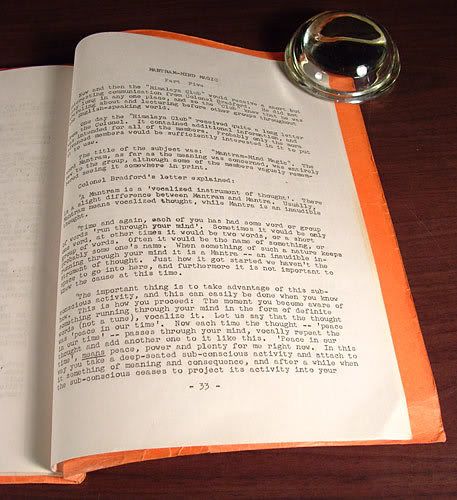
"As far as is known for certain, this is the only surviving copy of the 1946 edition of the Eye of Revelation! The first four sections of the 1946 edition are largely similar to the 1939 edition; however, section five is entirely new and contains information about:

* Tibetan Mind Magic
* Mantrams
* The Magic Quality of "Aum"
* and more.

The 1939 editions of the Eye of Revelation have earned millions for their publishers. This 1946 edition can do the same for whomever purchases it. It has been long, long sought after and--with the new, authentic, information--has every chance to outsell any previous edition many times over."
The pictures in his offering (pictures: 1, 2, 3) seem to be convincing evidence of it's authenticity. But I'd still take a documents expert and a lawyer with me before I coughed up $97,500!

He also mentions that the only known copy of the 1939 original is in the New York City Public Library. That was pretty easy to verify.

So, the very premise of the article in die Welt is in error. Ironically, it took Internet resources to check the facts from a traditional medium (a respected newspaper) which is supposed to be more reliable due to the presence of professional journalists and editors. And her facts came from what should be considered a reliable source: a senior librarian at a well-established major library.

But we still don't know who Peter Kelder was, who the English Colonel was, where these exercises come from, or how they really work (or do they?).

All of that is yet to come in "Dogs" - Part IV.

October 16, 2007

Moving in the old furniture

The Firm is in a state-of-the-art office building. With identical data outlet sockets in every room, modular office furniture, and an efficient office administration department supplied with plenty of hand trucks and burly workers, they can move a person's working space (including desk, files, computer, lamps, cabinets) from one room to another inside an hour. I recall the dizzy feeling of working in one room at nine in the morning, and being moved, and working somewhere else by eleven; phone working, computer on the network, cabinets and files set up. I'd never worked for a huge multi-national company before I came to The Firm, so I was unprepared for the psychological effects of being moved four times within my first year. At first I put up a fight and tried to ultimately personalize my space with art prints and interesting objects. Then each time I moved it took longer to unpack the boxes and get out "aesthetic" stuff. I've adopted a much plainer style of decorating my office.

Same goes for staking claim to a patch of cyberspace. I recall all the effort I went to creating my first websites: writing them in html, uploading them to my ISP's server with an FTP client, rewriting and uploading every time I wanted to make a change. Things are so much easier nowadays with Google and other on-line hosts. And there are other reasons I created pages. I was a very hands-on forum administrator for a few years, and I created pages of references for the members. And each time I changed ISPs or had to abandon a server for some reason, it would take a long time to motivate myself to upload my old pages and get them to work right again.

Blogging is a new medium to me. It took me some time to warm up to it. There were a few weeks I didn't think I wanted to keep doing it. There's a feeling associated with it that very much reminds me of the pressure of writing a weekly newspaper column. But there's a positive side to that pressure (which I realize nobody else but me is putting on myself), and that's the impetus to create.

So... I've decided I'm gonna be in this space for a while. I may as well unpack my boxes and decorate a little. You'll notice a new sidebar on the right containing links to some of the old html pages I mentioned above.

The first one, Resources for Dreamers, I created for a short-lived dreamwork forum I ran two years back. There's good stuff on that list. It took some digging on the Internet to find a lot of it. I actually have found more since I made that list, so I plan to update it sometime soon. Stay tuned!

The next one down, The Secret Archives, is one of the first websites I ever created, back in 2000. It's corny, and has that retro look to it. But I've decided to leave it as it is. It's a repository of my writing from the 1990s.

And the third link, Mystical and Occult Libraries and Text Archives, was something I created for a mysticism forum I moderated for several years. Those links also took some digging to collect. I've also found more to add to this list since I created it, so keep your eyes open for an update of that, too.

Phew! Unpacking and setting up house is hard work. But before I call it a day and crack open a beer, could somebody help me get this chest of drawers over to that corner over there?

October 10, 2007

Goin' to the dogs - Part II

What do Carlos Castaneda's The Teachings of Don Juan, the Golden Dawn's Cipher Manuscripts, and Peter Kelder's The Ancient Secret of the Fountain of Youth (the book on which the "Five Tibetans" phenomenon is based) have in common? They have all had a major impact on the lives of many people, and they have all been attacked by their detractors -- not without reason -- as being frauds.

Yours Truly has been wandering the highways and byways of the Internet, whacking around in the underbrush with several search engines, and he has discovered some interesting things. Interesting, indeed! All is not as it seems! Are you surprised?

Who was Peter Kelder?

What were the mysterious circumstances of "his" book's publication in 1939? The revision in 1947? 1975? The "updated" version of 1985?

Where the heck do these exercises actually come from?

All these questions will be explored in "Goin' to the dogs - Part III." Coming soon.

(Note: I am, however, still faithfully doing the exercises every morning. I'm up to nine reps of each rite every morning. And feeling great!)

October 7, 2007

A ritual is what it means to us

I was asked to write the following article for A Rózsakeresztes Tükör (The Rosicrucian Mirror), the official newsletter of the Rákoczy Atrium Group of Budapest, an affiliated body of the Hungarian Administration of the Rosicrucian Order, AMORC. It was translated into Hungarian for publication, but I thought a few English-speaking readers of this blog might be interested in reading it as well.

Since it was written with members of the Order in mind, it makes a few assumptions about previous knowledge of the readers that necessitate a brief introduction for the context of this blog.

First of all, AMORC has only existed in Hungary since 1994, since such non-socialist, international organizations were forbidden before 1990, and all forms of spiritual practice were discouraged (to put it lightly). AMORC has had its hands full with translating the vast volumes of correspondence lessons and with all the other administrative tasks involved in trying to establish and grow a large and sophisticated organization. Translating and organizing some of the more "minor" rituals and activities have been on the back burner for a long while.

Szilvi and I knew the Appelation Rite existed and was performed in other jurisdictions, and we asked if it would be possible to perform it for our youngest child. It took the better part of a year to arrange it.

The references to all the AMORC rituals I have seen is relevant in this country, where the overwhelming majority have not seen many of these rituals. It would be no big deal in North America, or even in Francophone Africa, where the order has been operating for a long time, and twenty-five-year-plus members are not a rarity.

Tata is a little city where the AMORC administration is located, and the only working temple in Hungary.

And with that introduction, let us proceed to the article.

A child, a family, a community is initiated

By Theo Huffman

With the exception of a Rosicrucian funeral -- and naturally all the initiations I haven't received yet -- I've seen just about every ritual performed by AMORC. I've helped perform the pyramid ceremony. I've seen installations of officers. I've seen the sanctifying of a temple. I've even seen a Rosicrucian wedding. But I'd never seen the appellation rite. I'd often wondered what it would be like.

I'll confess that I was just a little skeptical. Let me see if I can explain why.

The first thing you need to know is that I was raised a devout Catholic, and every Catholic knows there are seven sacraments (baptism, communion, confession, confirmation, marriage, holy orders and last rights).

The second is that The Rosicrucian Order AMORC hasn't always had the stable, highly-developed form it has today. When H. Spencer Lewis[1] accepted the task of creating a visible Order in the physical world to embody the work of an invisible fraternity which has existed for thousands of years, it was the ultimate creative challenge. Carrying out this work in a world totally transformed by mankind's technologies since the days of the Fama Fraternitatis was only possible for someone who had the courage to experiment with new ways of bringing esoteric knowledge to those who wanted and needed it.

And H. S. Lewis was a real experimenter. Many of those experiments developed into the teachings and ritual we know today as our traditional Order. But many of the experimental projects, such as the creation of a "universal Rosicrucian language" (sort of like Esperanto) were found to be unworkable, and consequently abandoned. And among these abandoned projects was the creation, in the late 1920s, of a Rosicrucian church, called "The Pristine Church of the Rose Cross." Dr. Lewis served as the bishop of this church. The church only lasted a few years, the Order's first years at Rosicrucian park. After this, it was decided that the energies spent on the church would be better invested on other aspects of the Order.

So, I suspected the appellation rite might be a legacy of the early AMORC's experimentation of trying to create a church, which necessitated it to have its versions of the seven sacraments. I have to smile a little when I think of one of our Rosicrucian friends calling it a "Rozsakeresztelo~"[2].

But I was pleasantly surprised.

When we arrived at the administration in Tata, and as the enthusiastic members arrived, as well as our two invited guests, Timothy was quite shy, and clung to me. I think he was well aware that all this commotion centered on him. And the energy was especially intense, since this was the first time the ritual would ever be performed in Hungary.

Szilvi and I were asked to wait alone in a room with our son Timothy while everyone else entered the temple and prepared for the ritual. When the door opened and the Outer Guardian[3] asked us to come with him, I got my first hint that this was an initiation.

Although the appellation rite is open to non-members who are invited by the parents, (unlike most other AMORC rituals) I still feel it would not be right to describe something that happens in the temple in too much detail. It is something to be experienced in the temple, not something to be described to people in the mundane world, or "the outer darkness" as we call it when we are in the temple.

Timothy continued to be very apprehensive as we entered the temple and took our seats. I'll confine my remarks about the ritual to a few observations. It bears no resemblance to a baptism at all. It is truly a Rosicrucian initiation. The child is initiated by means of a symbolic journey through three stations of the temple, which to my mind is an allegory of birth. Timothy cried at the first station, since we had to put him down to sit on his own. And this seems appropriate. There is always crying at birth, isn't there? At the second station, among other wonderful events, the child gets a kiss on the cheek from the Colombe.[4] Timothy was so surprised, and so delighted, his eyes lit up like candles as he watched her walk away. Is there anything sweeter than an encounter with the Inner Self?

Finally, it really emphasizes the point that this is an initiation when, at the third station, the parents are asked to take an oath. What did we promise? You'll have to come to the next appellation rite to find out!

The mood afterwards was very joyous and light. Timothy was suddenly more open and social, and like everyone else, he was very happy to be able to indulge in cake and cookies. And perhaps this was a moment that was somewhat "church-like." The community had gathered to observe a milestone in the lives of one of its families. That's a point I shouldn't miss. This ritual was very important to our other three children. To see Timothy acknowledged by the Rosicrucian community, and to see their parents take a vow regarding Timothy, was surely an important spiritual experience for them, too.

Szilvi and I were both convinced that Timothy was "different" after the ritual; somehow more aware, more present in the world. And this I take as one more confirmation that the appellation rite is not just a pseudo-baptism. It is a true Rosicrucian initiation.

1. H. Spencer Lewis (1883–1939) was the founder and first Imperator (supreme officer) of AMORC.

2. A subtle play on words in Hungarian. Keresztelő in Hungarian means baptism. Rózsakereszt means rosy cross. Put them together and you have a "rosy baptisim".

3. A traditional ritual officer

4. A role played in ritual by a girl in white robes and headdress. Her name comes from the Latin columba, meaning: dove.

October 3, 2007

Goin' to the dogs, Tibetan style


Anyone who knows me to any extent, knows that I get up obscenely early every morning (4:30am) and engage in morning yoga. I call it yoga, because it's too complicated to tell people that it's actually a combination of exercises I've assembled over the last twenty-odd years from the different systems I've learned. My routine has continuously changed during that time, and contains elements of aikido, t'ai chi, chi kung, and hatha yoga.

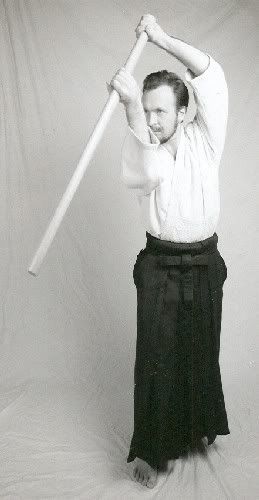
It all started when I was a fanatical aikidoist in my twenties, and started each day with bokken (wooden sword) practice. I always had in mind that my routine, whatever it consisted of at any given time period of my life, was a spiritual discipline, and not just a physical workout (though my aiki weapons routines used to make me sweat very nicely), which meant that the last part of the routine was always meditation.

As life got more complex (read: having to earn a living and nurse literary ambitions) and commitments increased (read: wife and children), I always strove to create the "ultimate" series that was relatively brief, still hit most of the muscles and joints in the body, and prepared the mind for meditation.

In August, while attending the AMORC World Convention in Berlin, I roomed with a member from Hungary. Every morning, he did a short series of five exercises. What got my attention was that they started with an exercise consisting of holding one's arms out, palms down, and spinning clockwise. I was already doing this exercise as part of my morning routine, but I'd picked it up from a book by Joseph Weed that had been out of print since the 1970s; a source I thought was pretty obscure. He showed me a Hungarian translation of the book Ancient Secret of the Fountain of Youth by Peter Kelder. He offered to loan it to me, but since I don't like reading English books in foreign languages, and since I felt I already had "my" routine, I politely turned him down. But I was really intrigued that the spinning exercise was the same as the one in the Weed book, although Weed said it was part of the training of an ancient Greek seeress. (I think the Weed thing is material for a future posting).

So a little over a week ago, I was researching something on the Internet, when I started getting hits for The Five Tibetan Rites, including this video.

Have you ever considered how that element of randomness to Internet searches makes the Internet kind of "oracular"? I mean: I don't know about you, but I seem to often "stumble across" things just at the very moment I need them in my life. Well, this Five Tibetans thing was popping up pretty often, so I decided to go for it. So now I've incorporated them into my morning routine. More than that: they've become the basis of my morning routine. I use a little chi kung twist to warm up my spine, and an aikido weight shifting exercise to get the circulation going in my legs and arms, but the heart of the workout is The Five Tibetans.

It's only been five days, and I can already feel things happening in my body. Yesterday and the day before I kept getting these warm sensations in my lower back like someone was holding a hot water bottle up against it. Yesterday I used it as the warm up for my every-third-day jogging session instead of my usual warm ups. I was bouncing down the sidewalk like a rubber ball the whole way (yee-haa!). Best run I've had in months!

There are all kinds of theories about why it works, and I have some thoughts on that, but I need to get to bed so I can get up and do my exercises in the morning. ;-)

Maybe I'll have to blog about this more later.


September 28, 2007

Swing Low Sweet Cybercoach

I slumped into the back seat of the dark taxi cab, ready for a quiet and mindless ride home from the office. It's rare that I take a cab home, considering that Budapest's public transport system is so extensive and I rarely work late. But The Firm's been working on a huge project that's coming up to deadline, and I'd stayed at the office until at least 9:30 the last five workdays. And The Firm pays for taxis if you stay really late.

As the cabby and I exchanged the necessary small talk to establish where he was taking me, I noticed a little screen on his dashboard showing a music video. The music was coming from speakers behind me. For a moment I leaned my head back and luxuriated in the sensation of being able to relax and not force myself to keep working.

"I can turn the volume down if it's too loud for you," the cabby said. When he turned toward me, I noticed his short grey hair, wire-framed glasses riding down on his nose, and his meticulously trimmed white Van Dyke beard gave him a grandfatherly aspect.

At that moment Depeche Mode's Precious was playing.

"Oh, no. I like this."

He cranked it up. I was a bit confused.

"Is this TV or a DVD?"

"Neither," he said, "This is a PDA. I hooked it up to the car's hi fi. I just load gigabytes of music videos on it from various sources. Lots of my passengers like it."

Another video started.

"Should I turn it down?"

It was Enigma's Sadeness. (No, that's not a misspelling!)

"No, that's fine. I like this, too."

He looked back over his shoulder with a knowing smile. We have similar taste.

The whole scene began to strike me like a cyberpunk fantasy. This wasn't one of the increasing number of sleek Mercedes taxis or other late-model hacks plying the streets of Hungary's capital (the banks have figured out that making car loans to taxi drivers is a good investment). It was a somewhat seedy Opel Astra, and the setup for melding the PDA with the audio system included a few more cables and brackets than anyone with a less geeky aesthetic sense would put up with. And it just had that sleazy William Gisbon kind of hawking-high-tech-in-the-back-alley feeling that my host could pull this off by cobbling together 1) an off-the-shelf machine that's essentially an overgrown address book 2) an amplifier and two speakers, and 3) digital media from dubious sources. We live in the future. Time is getting warped.

I told him I really loved one song from Enigma's first album, called Callas Went Away. I didn't tell him that I actually once wrote a poem based on what that song meant to me. We had some communication problems with me trying to convey to him what the title meant in Hungarian, and that the song was a tribute to Maria Callas. Nonetheless, he was interested, and said he'd look for it.

I didn't recognize the next video.

"What? You don't know 'Fateless'?" the driver asked. "Here, let me show you his most famous song."

He reached out with his index finger, and while he negotiated traffic, he also deftly navigated menus on the PDA's touch screen. Until he'd queued up Faithless's We Come 1. OK, so I live in a cave. I'd heard or seen the name Faithless before. I just don't watch music television or go to clubs, or spend lots of time with people of the age who'd listen to it.

I found the video intriguing, and would even say poetic. Which is saying alot, if you consider my basic aversion to anything rap-like. I like the way events play out inside a room that would by nature take place in a larger outdoor space. It gives the action the sense of being a fantasy, or suggests that what we see is always only part of something larger. It makes it real "trippy", too. Riding in a taxi through Budapest, it was stirring when the words "cold war" echoed between verses. (Which I later realized I'd misheard. It's the distorted repetition of "come 1, come 1. come1").

The video handles the theme of duality and division very artfully, using images of street protests and riot police to embody the lyrics:

"I am the left eye/ you are the right/ would it not be madness to fight."

We pulled up to my apartment building, and we sat (with the meter stopped, naturally) and watched the video to the end before we got down to the business of paying and making the obligatory receipt. I tipped him well (I'm so generous with The Firm's money!), and we shook hands heartily. I got the sense that this had not been your average taxi ride for either of us.

Instead of dragging myself out of my seat, I found that despite working ridiculous amounts of overtime for days, my cyberpunk taxi ride had a put a bounce in my step again.

September 22, 2007

Surprise Consultation

The Firm had fully taken over the resort hotel by Friday night. Dance music flooded the foyer, and bodies bobbed in colored, dim lighting. The Firm is a wealthy and powerful multinational (about as multinational as they get; with offices in almost every country of the world), and when it takes its personnel out of town for all-company functions, it does it in a big way.

After these several hundred souls had been crammed into an auditorium as the captive audience of endless presentations for a large part of the day (and cursing the fiends who created Power Point), and then wined and dined at The Firm's expense, everyone was releasing their tensions (not only of the day, but accumulated over months!) in the massive party, as the free booze flowed.

In a big way: the entire cavernous hotel lobby had been redecorated and re-lit. A stage had been built on one end for the featured band. A wooden dance floor had been constructed to protect the permanent floor.

The party had a 60s theme. Lots of mini dresses and mini skirts. Multi-colored polka dots everywhere.

Wandering among the crowd with my glass of dry red, I stumbled upon the encampment of my colleagues. The lawyers in this firm tend to be clique-ish, and don't mix much with the other professionals. They had commandeered several long couches and long tables next to a large-screen TV running with the sound muted. It was showing a war movie, and no one was paying much attention. Many of the combatants were wearing those unmistakable Afghan hats.

As I approached them, he saw me and made eye contact. He (let's call him Peter) jumped up from the couch and came to meet me before I got very close to the rest of them. Peter had an urgent expression on his face.

"I want to ask you something," he said, leaning close to compensate for the loud music.

"My God! That sounds awfully serious," I half joked.

"Oh, it's not about you. It's about me."

"That still sounds serious."

You see: Peter and I aren't close in any way. We see each other at the office, and he lingers a minute or two to talk when he has to come consult with me about a document of his I'm editing, but the fact that I'm not a lawyer, and that I'm not Hungarian, and that I'm twice his age, and countless other factors, make it a distant (if friendly) relationship. I recall when he started at The Firm several years back, I noted that he was a strikingly handsome man, as far as I am a judge of masculine beauty. And his soulful eyes told me that he was likely sensitive and passionate. At any rate, it came as a surprise that he wanted to pour his heart out to me. And I could feel in my bones that's what was coming.

He looked into my eyes, almost pleadingly, and asked, "What do you do when a woman breaks your heart?"

I paused, aware of his eyes fixed on me. He really wanted an answer. Not a time to be flippant or dismissive. I thought, as well as one can in an environment of throbbing pop music, and a million LCDs depicting a night battle in rugged hills, complete with flashing explosions (certain clues told me what was being depicted was the siege of Tora Bora).

There was no doubt Peter had picked the right person to ask. My second wife shattered my heart so thoroughly, it took me years to gather all the pieces together again. And it took the flames evoked in that broken heart by my current wife and the children she bore me (not to mention being reunited with my first child) to fuse it back into one piece.

Is that why he came to me? Had someone in The Firm told him about my history? (Not likely, since I don't really talk about such things at work.) Or was it just that I'm old enough to be "fatherly" to him?

I knew what he wanted to know was how one got over it. And I didn't really have an answer for that. My experience was that the only thing that really made a difference was time.

He must have read my mind.

"I guess," he said, "It's just a matter of time."

I nodded. He nodded, sighed, looked down at the floor, his shoulders drooping.

"Who broke your heart?" I regretted the indiscretion as soon as I'd said it.

"I think you know."

"No, I don't."

Within a few seconds I reviewed memories of people I'd seen him socializing with. Two candidates came to mind. I'm not innocent enough to be shocked, but I was surprised, since one is married and the other has a very significant other.

He was about to turn and walk away when something occurred to me.

"There is one more thing," I said.

His eyes opened a bit wider.

"I know you probably don't feel like it now, but once you get over the initial hurt, you have to forgive her."

He didn't say anything. He just continued looking at me. He was trying to understand.

"If you don't forgive her, it will eat you up from inside. It can destroy you."

He was still silent; still watching. I decided I'd gone this far, I may as well go a little farther. The soldiers on the screen had gotten the signal to advance; scores of men with weapons running up the side of a mountain.

"My father never found it in himself to forgive my mother after she left him. I watched what it did to him. I think it slowly destroyed him. He never really got it together again. He never really learned to trust anyone or love anyone again."

Peter was nodding and his eyes had that distant look of internal reflection.

We stood there a bit longer, our drinks in our hands. On the screen, it was the morning after the battle. Some middle-aged soldiers with CIA written all over them (metaphorically that is) were combing a rubble-and-body-strewn cave for useful intelligence. One of them freaked out when he found a dialysis machine.

"That's about all the wisdom I can muster at this point," I said.

He smiled. "Thanks," he said.

He drifted back to his pals, and I walked over to one of the lawyers who's closer to my age, cocked my head in the direction of the dance floor and said, "Let's go dance." We left the legal eagles and the war in southern Asia behind, to lose ourselves in the rhythms of hundreds of bodies forgetting the pressures and the heartbreaks of daily life on this planet. Dance. Forgive. Learn to love again.