Showing posts with label rosicrucians. Show all posts

August 20, 2008

Bringing Mysticism to the Office

The following article will appear (in Hungarian) in A Rózsakeresztes Tükör (The Rosicrucian Mirror), the offical newsletter of the Rákóczy Pronaos, a subordinate body of The Rosicrucian Order AMORC.


Have you gotten very frustrated or angry with some situation or other at work recently? Do you have a colleague who really irritates you? Perhaps someone who has decided they are your enemy, and does dishonest or unethical things to sabotage your projects or your reputation? Do you feel you are stuck in a soul-killing job with no chance of moving on to something better? Do you sometimes feel you aren't smart enough, fast enough, young enough, or skilled enough to do your job properly? Are you afraid of losing your job? Do you have troubles communicating with people at work?

Have you thought of applying mystical principles to any of these problems? No? Why not?

Rosicrucianism is a mystical philosophy, but what has always distinguished this philosophy is its emphasis on the need to apply the mystical principles it teaches to everyday life. When the Rosicrucian student looks closely at the challenges his life presents him with, he can easily discover situations that can be positively influenced by employing methods he has learned from the Teachings. He can use breathing techniques to stay calm in times he knows will be stressful. Visualization can attract objects and/or circumstances he needs for his or someone else's evolution. Meditation can bring understanding to puzzles we must always solve to progress in life.

But somehow, it seems more natural to apply these things to our personal lives, to our family relationships, to our friends, and to our home. But where we work seems to be a different matter.

But it shouldn't be.

Part of this attitude is a result of the nature of work ever since the Industrial Revolution. There was a time when one's work was something one inherited from one's family. If your father was a farmer, then you were a farmer. If your father had a trade (blacksmith, shoemaker, carpenter, etc.) then you learned that trade. And work wasn't separated from life the way it is today. Children played at the edge of the fields their parents where cultivating, and when they were old enough, they worked alongside them. The trademan's shop would be part of the family house, and the mother and children would come and go all day long.

Nowadays, we often have the attitude that a job is something we do just for money. It isn't our land we are cultivating; it isn't our goods we are producing in the shop; it's not in our name we are rendering the service. We feel detached from our work. We feel it has little to do with our "real life". We feel it is unrelated to who we really are.

Nonetheless, we spend upward from 40 hours a week at work. We spend the majority of our energy on work five days a week, and we often spend more time with our colleagues than we do with our families. And the people we spend time with at work are "real" people. They are souls; sparks from the divine fire, just like ourselves. If we pay attention to them, we will realize that every day at work presents us opportunities to serve these various people, even the ones who are hostile to us. No. Especially the ones who are hostile to us!

Regarded in the right way, we realize that wherever we work we will find challenges that offer us the opportunity to grow as spiritual beings. If we approach work this way, it no longer seems a dreary, boring, tedious place where we feel the life draining from us every hour we spend there. The workplace is transformed, as is our relationship with everyone and everything there.

Techniques for transforming our work experience

One quick way to transform work is to start the workday with an invocation. It can be a very simple invocation (or prayer, if you prefer this word). All it has to do is serve to raise your consciousness and make you aware that the time spent at work is as much a part of your mystical quest as any other part of your life. Here's an example:

Work Invocation
God of my heart:
May the still, small voice within guide my actions as I work today.
May it point out every opportunity to learn new lessons from the situations I encounter.
May it show me every chance to serve that comes my way.
May it help me to engage myself in my work with interest and enthusiasm, and may it help me guard against laxity and apathy.
May I be inspired to do my work with dignity and honor.
So mote it be!

Saying your invocation at your desk, and then spending a minute or two in meditation will make a big difference to the way you vibrate within your work environment. Even if you don't have much privacy, you can still say it to yourself silently and close your eyes for a moment afterwards.

Another technique addresses the problem of being overwhelmed by events at work and not being able to stay focused on the most important tasks. The modern workplace is full of distractions: ringing phones, e-mail alerts, colleagues popping in the door at any moment. It can be difficult to stay on track and do the things we planned. Sometimes we can come to the realization at the end of the day that we haven't done any of the things we planned. We let ourselves get distracted.

In this case, it can be useful to use a little time when we are away from work to project our energy into the future. During a few moments on the weekend, or in the evening, when you are calm and clear-minded, go into your sanctum and picture yourself at work calmly and efficiently performing the tasks you have decided are important and need to be completed. Naturally, you should be specific, and imagine yourself doing only those tasks you want to focus on. Of course it is important to inject emotion into the visualization: feel the joy of accomplishing important work. If you do this a few times before you go to work, you will find that it becomes easier to stay focused on the tasks you visualized, and that the tasks are accomplished more easily. This is an important mystical technique: preparing for stressful situations while we are still calm and clear-minded.

Although our workplaces are filled with electronic communications devices, there is still a place for old-fashioned communication: no I don't mean face-to-face communication, I mean psychic communication. There are various reasons why people in professional situations might miscommunicate. They are distracted by their personal feelings for one another. They're distracted by the pressures of the office. One or more of the people in the conversation are blinded by their feelings of superiority or inferiority. The list could go on, but suffice it to say, there are many reasons why verbal communication isn't always as effective as one would like. For this reason, it is often good to send someone a psychic message before you talk to them. Using the methods taught by our order, you can telepathically tell them the essence of the message you wish to give them days or hours before you say it to them personally (or on the phone, or by e-mail). It is likely they won't consciously recall the psychic message, but when you speak to them, the message will already seem familiar to them, and they will be more likely to understand what you wish to say. And they will be more likely to be receptive to you message, especially if you visualized them as being receptive. And repeating a message psychically after you have spoken to someone helps to make the impression of what you said go deeper.

Visualization can also help smooth out conflict in the workplace. If disharmony arises between you and another person in the workplace, it can be very useful to spend time each day visualizing love, in the form of pink light, emanating from your heart, and surrounding, nurturing and protecting that person. Naturally, it can't only be a sterile visualization: in order for it to be effective, you really have to feel love for this person. That's the challenging part of the exercise. But the results can be miraculous.

Meditation can, naturally, be used as a tool for solving problems one encounters at work. Once you have worked on a problem with your conscious objective mind as far as you can go, send the problem, in the form of a simple question, into your subconscious, and wait for your inner self to suggest the solution to you.

As suggested in the invocation, it is important to see the workplace as a school, just like the rest of life. When difficult and puzzling situations arise, it can be rewarding to ask yourself what the lesson is that can be learned from it. The workplace is especially fertile ground for this, because we are forced by circumstances to deal with things we might isolate ourselves from in home life, and among friends and acquaintances. But at work, you can't avoid them. You just have to deal with them.

Work can be very draining and tiring. Remember the exercise that comes in the very first monograph that every member is mailed? It's a technique for reviving yourself with psychic energy when you are tired. Have you ever used it at work? Why not? And that's not the only technique in the monographs for increasing one's available energy. Perhaps it would be better to use one of these techniques the next time you are tempted to grab another cup of coffee.

The same goes for techniques we learn for staying calm under stress. The techniques are there. We can only blame ourselves if we don't use them.

Conclusion

The workplace is an excellent opportunity to use the techniques we acquire through AMORC's teachings. Applying the teachings counteracts the feelings of helplessness the modern workplace can often impose on employees, by letting us demonstrate that we can have a positive influence on events at work. Not only can they make professional life a bit easier and more successful for us, they also make us more effective members of the teams we belong to, and a source of health and harmony to the entire community we work in.

July 30, 2008

You Call THAT Summer Reading?

Although four days ago I escaped the urban circus of Budapest for the idyllic peace of a farm house in southeastern Hungary, far, far from TV cables and internet connections and subway trains and all the other features of my harried life (which I love, but gets a bit much after a while), through the miracles of online technology this posting is being published on my appointed publishing day, thereby keeping my promise to grace the world with another dose of my prose every Wednesday. (Note to self: I should suggest to Google that they develop an application called iStiff, which sends an indistinguishable virtual image of a nine-to-five employee to the office through the internet every weekday morning, while the real employee stays home and putters around the house, blogs, meets friends at cafes, etc. Sounds like the Next Big Thing, huh?)

As this digital missive is being released into cyberspace, its flesh-and-blood author will have already spent days breathing fresh air, taking walks in the woods, watching his kids play with farm animals, cooking meals for ten (we'll be there with another family with children), watching the stars in a clear sky free of city lights, and... READING!

Now, being a corporate editor, reading on vacation is a bit like a busman's holiday, but as any professional reader (or college student) will tell you, there's a world of difference between reading what you have to, and reading what you want to.

Admittedly, being on vacation with that many children doesn't really allow for that much reading time, which is why I have to make every minute of it count. So... no mental-chewing-gum potboilers for me. Why waste that quality time away from the frenetic life, while my blood pressure is down and my brain waves smoothed out to gentle curves? No, I'm going to bring along two books that are definitely not what most folks would consider light beach reading.

The first is a novel. I don't read many novels anymore. First of all, I don't have time for them. I recall when I was younger, being very disdainful of people who say they don't have time to read. But, now I'm in that position. A full-time job, four kids and a commitment to spiritual exercises doesn't leave much time for other things. And the truth is, I do read. But shorter stuff I can squeeze in while commuting or eating lunch: articles on subjects I'm interested in, short stories (especially from my favorite speculative fiction site Strange Horizons). I read chapters from e-books on subjects I'm researching. But novels, no. You have to have long stretches of time to read novels. Reading a three-hundred page novel at a rate of four pages a day is very frustrating.

So, there's this six-hundred-page book I started,...uh,... a year ago on a bus ride to a company outing. I got one or two chapters read on the bus. Then I struggled for a few weeks at three or four pages a day and gave up. Around Christmas I took the time to plow through half of the book, and gave up when vacation was over. At this point I still have 170 pages of Gustav Meyrink's The Angel of the Western Window left.

Many of you will know the name Meyrink as the author of The Golem, but far fewer people know that Meyrink was actually an initiate of the western esoteric tradition, and that he wrote a number of esoterically significant novels. The plot of Angel takes place in two different time periods. One is the lifetime of Dr John Dee (1527-1608), and the other is the lifetime of the first-person narrator, a bachelor gentleman in Vienna in the early twentieth century. We slip into John Dee's time whenever the narrator reads Dee's diaries. I won't spoil the story for you (because you really should read it), but suffice it to say that the interaction between these two times and personalities becomes very bizarre and intricate.

Dr Dee was the Renaissance man's Renaissance man. There's hardly an art or science this man didn't dabble in, if not excel at or pioneer, including magic. And this novel is very much about the magical side of Dee. And the sweep of the novel is incredible: England and Wales, Emperor Rudolf's Prague (including Rudolf himself), Vienna, and more.

I've really worked myself up! I can't wait to get back to it.

The other book I'm taking along is a very thin, but very dense volume by Dr John Dee himself: The Hieroglyphic Monad. I've been wanting to delve into this book for some time now, but just haven't felt the time was right. This is the type of book Georg Kuhlewind would designate a "contemplative book". That means that, unlike a light novel, or an instruction book, or a magazine article, it is meant to be absorbed a few sentences at a time. The prime example of such a book, according to Kuhlewind, is the Gospel of John. One should, he says, read a sentence or two, and then deeply meditate on them to see what they evoke from deeper levels of consciousness. I'm certain this is how the Monad is meant to be read. It is divided up into 24 short theorems, each short enough to read in a few minutes. So, in the afternoons, after lunch has been served and the children are playing in the yard, or in the barn, I plan to drag a comfortable lawn chair out under a tree in the yard, sample a theorem, and then slowly sip my tea and contemplate.

Slowly. Patiently.

March 12, 2008

Developing a relationship to fairy tales - closing remarks (part 2)


(To interpret, or not to interpret?)

Why is it important that these stories are a mixed bag, and don't neatly fit the categories scholarship has created for them? Because seen in this way, one can appreciate that all of the approaches I've mentioned so far in this essay, as well as many others I haven't mentioned, are legitimate in their own rite.

But precisely because there are many different kinds of narratives lumped together under the rubric of "fairy tales," one has to be careful which methods one applies to which fairy tales.

Again, there's an apt comparison to dreams and dreamwork. When working with a dream, it is essential that the dreamer feels deeply within his intuition to determine what kind of dream is in question (I credit Robert Moss and his book Conscious Dreaming for making this clear to me).

Let's say that you dream your uncle Charlie comes to you and tells you that your boss has a sharp sword in his office and he plans to cut off your head the next time you go there. In order to begin working with this dream, the dreamer has to decide whether it is a) transpersonal, b) prescient, or c) psychological (or another type of dream, but this covers the big categories). The dreamer has to ask himself: do I really feel that uncle Charlie came to me? Or does the image of Charlie represent something? If he feels it really was Charlie (i.e. a transpersonal dream), then it would be foolish to try interpreting Charlie as a symbol. One would miss the entire point! If one feels Charlie is a symbol, or represents a principle or "archetype" (i.e. it's a psychological dream) then one would apply other tools. The dreamer would also have to ask himself "do I feel this dream is speaking of the future?" If yes (i.e. it's a prescient dream), then the manner of treating this dream would, again, be different.

Using the wrong tools on a given dream yields dubious results. The same applies to fairy tales, especially considering the types of fairy tales that Rudolf Steiner and Werner Zurfluh are talking about. If the narrative speaks of a hero who must cross a threshold into another world, and the terms of the story indicate that what follows is the hero's psychic experience, it does very little good to get out all the tools of literary analysis and try to interpret this passage or the subsequent passage (dealing with the hero's adventure beyond the threshold) with post-modern, post-colonial, feminist, queer, hermeneutic, Jungian, Freudian, structuralist or any other type of criticism. It just misses the point.

And another parallel between dreamwork and "fairy tale work": It's very important that you base your own understanding of a fairy tale on your own experience. There is great danger in abdicating to so-called experts one's own right to decide the significance and meaning of aesthetic artifacts. Just because someone has degrees from respected institutions doesn't automatically give them insight into matters as deep as the ancient stories told by our race, nor into the meaning of creative inspirations from sources deep within our beings. The modern world regards the word inspiration, which means "to breathe in the spirit", as a quaint, colorful, but ultimately antiquated metaphor. Creativity is believed to arise in the physical brain. The average educated person believes that all the meanings of artistic creations can be found by means of various intellectual, analytical processes. And this is patently untrue. There are some things the objective mind cannot penetrate. Let's look again at that remark Rudolf Steiner made about symbols:

"Explanation and interpretation of symbols is really nonsense; so too is all theorising about symbols. The true attitude to symbols is to make them and actually experience them. It is the same as with fables and legends and fairy tales. — These should never be received merely abstractly, one must identify oneself with them. There is always something in man whereby he can enter into all the figures of the fairy tale, whereby he can make himself one with the fairy tale. And so it is with these true symbols of olden times, which come originally from spiritual knowledge..."

Many people are confused when you tell them that you should not focus your efforts on interpreting fairy tales, just as they have troubles understanding how you deal with dreams without immediately jumping to the interpretation. That's what the intellectual culture we've been brought up in tells us to do. Everyone has seen films in which there is someone lying on a couch and telling their dream to a shrink, and the shrink tells that person what the dream means, right? Your English teacher in high school (or English professor in college) gives you a poem or a story, and you're supposed to analyse it and interpret it, right? So, naturally, when you get something as highly symbolic as a fairy tale, which anyone with a couple of live nerve endings and a remnant of the natural in-born sense of awe knows is just pregnant with significance and meaning, what do you think you're supposed to do with it? Interpret it, of course! Wrong.

What can you do instead of interpret? If you have graphic skills, you can take a page out of the Waldorf school book and draw or paint the motifs of a fairy tale. You can act them out with friends and family playing different roles (OK, I admit I've never tried this with fairy tales. But I have tried acting out dreams with friends. Powerful stuff!) You could simply review the dream in your mind and then journal about the episodes in your life it reminds you of. You can use a tale, a part of a tale, or even just an image in the tale as the subject of a meditation. The possibilities are up to your own creativity. But the most important thing is to read them repeatedly. If you have children the right age to tell fairy tales, you are blessed. You don't have to contrive a reason for reading them, nor to justify the time you spend reading them. And there is also something special about reading them out loud. You get to experience the tales as a fringe benefit of doing service for your children. And never doubt for a moment: reading fairy tales to your children is a great service.

One last remark. I apologize to anyone who takes umbrage at my sometime somewhat dismissive attitude to the discipline of psychology. As the old joke goes: some of my best friends as psycholgists (I just wouldn't want my daughter to marry one!). The reason for this is that, despite an increasing number of enlightened individuals among their ranks, there is still a frightening number of them who fail to be human when examining the human mind, and who feel it is their duty to destroy and discredit anything that supports a viewpoint based on the divine nature of man's essence (the soul), mistakenly believing they are fighting superstition and ignorance, when indeed they are only showing their intolerance and ignorance of things beyond the ken of their particular sub specialty.

The blinders that give many psychologists tunnel vision is a combination of materialism and the limits imposed on them by the scientific method. Materialism is a state of mind that refuses to acknowledge anything beyond the physical senses (or the measurement instruments that represent an extension of our senses). Unfortunately, dealing with the products of the subconscious and the imagination does not always yield easily repeatable results. Instinct, emotion and intuition are equally as important as reason and logic. And although many psychologists would like to stake out the territory of fairy tales and dreams as their own, in which non-shrink dilettantes dabble at their peril, they forget that dealing with these worlds is much more an art than a science. And these realms are everyone's birhtright.

March 4, 2008

Of heptads, rebirth, solar energy, tai chi and everything

It's a special day today. I'm buzzing with enthusiasm. Now lots of people especially in our youth-oriented culture would say I'm completely nuts about being happy it's my 49th birthday today. But I am. I've been looking forward to this day for weeks.

It all has to do with cycles of seven. Rosicrucian teachings say that human life unfolds in cycles of seven. First of all, there are seven days in the week. Then the years can be divided into seven periods of 52 days each, and then there are cycles in our lives consisting of seven years each. Anthroposophists and Waldorf teachers and parents will be familiar with the latter. Well... I have now finished the last year of a seventh cycle of seven. Something very "complete" about that. And what makes this year, and especially this day, so special?

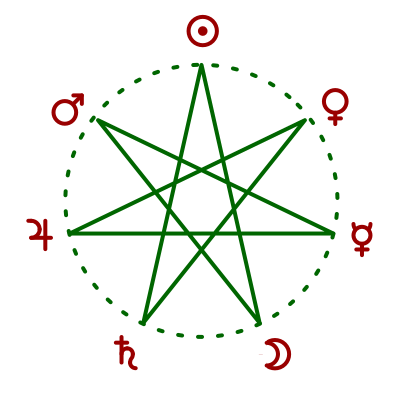
Look at the star illustrating this posting. That star can be found in the Occult Philosophy of the Renaissance mystic/philosopher/magician Cornelius Agrippa, along with explanations of how to use it to calculate the planetary influences of a given day and hour. Every week starts with the day of the sun (Sunday), followed by the day of the moon (Monday) and so forth, following the lines of the star. The first hour of Sunday is the hour of the sun, followed by the hour of venus, following the points of the star clockwise. There are 24 cycles of seven hours per week, bringing you back to the hour of the sun in the first hour of the week. So, obviously the first year of each cycle is a solar year, and the first cycle of seven years is the solar cycle. So... I have gone through seven cycles, meaning this new cycle of seven is a solar cycle. This is the first year of that cycle, so this is the solar year, And this is the first 52 days of that year, so this the solar section of that year. And it's the very first day!

I am reborn today!!!

The wind is in my sails! And I know I had better take advantage of this, and use all this energy wisely, because times of such positive momentum are precious. Honestly. I feel an electric buzz all through my body and mind.

It was thinking a few days ago that I needed to do something special to mark this occasion, when I got a serious brain wave. And here's what occurred to me.


As my loyal readers know, I started relearning the Yang tai chi form about five weeks ago. I say "relearning" since I learned a short version of the Yang form in an Experimental College class at UC Davis, back when I lived in northern California. First of all, that was twenty years ago, and I didn't really remember much of it anymore. And I don't recall – if I ever knew – what particular style of Yang tai chi my teacher taught, but it wasn't as rigorous, nuanced, or detailed as the form taught on the videos of Erle Montaigue. Essentially, I had to learn it over from scratch.

Well, two days ago it occurred to me that I was only two moves away from finishing the first third of the Yang Cheng set, which is considered to be a short set in an of itself. I realized that if I busted my butt and learned the last two moves, I could do the whole set. That represents an accomplishment to me. Five weeks of daily work to not only regain something I could do in my late twenties, but to even learn it at a higher level than I could do it back then.

For the first time, this morning, the first day of the first 52-day cycle of this first year of the second solar seven-year cycle of my life (hope you could follow that), I performed my new Yang Cheng Fu tai chi set. It was still dark outside, and my family was still asleep, but I felt vibrant. What a wonderful birthday present to myself!

In a few weeks, once I've ironed some of the nastier wrinkles out of the form, I'll have my son make a video of me doing the routine, and I'll upload it to the blog.
I'll have a big party next year to celebrate my 50th, but that'll be for everyone else. This year's the important milestone to me.

October 7, 2007

A ritual is what it means to us

I was asked to write the following article for A Rózsakeresztes Tükör (The Rosicrucian Mirror), the official newsletter of the Rákoczy Atrium Group of Budapest, an affiliated body of the Hungarian Administration of the Rosicrucian Order, AMORC. It was translated into Hungarian for publication, but I thought a few English-speaking readers of this blog might be interested in reading it as well.

Since it was written with members of the Order in mind, it makes a few assumptions about previous knowledge of the readers that necessitate a brief introduction for the context of this blog.

First of all, AMORC has only existed in Hungary since 1994, since such non-socialist, international organizations were forbidden before 1990, and all forms of spiritual practice were discouraged (to put it lightly). AMORC has had its hands full with translating the vast volumes of correspondence lessons and with all the other administrative tasks involved in trying to establish and grow a large and sophisticated organization. Translating and organizing some of the more "minor" rituals and activities have been on the back burner for a long while.

Szilvi and I knew the Appelation Rite existed and was performed in other jurisdictions, and we asked if it would be possible to perform it for our youngest child. It took the better part of a year to arrange it.

The references to all the AMORC rituals I have seen is relevant in this country, where the overwhelming majority have not seen many of these rituals. It would be no big deal in North America, or even in Francophone Africa, where the order has been operating for a long time, and twenty-five-year-plus members are not a rarity.

Tata is a little city where the AMORC administration is located, and the only working temple in Hungary.

And with that introduction, let us proceed to the article.

A child, a family, a community is initiated

By Theo Huffman

With the exception of a Rosicrucian funeral -- and naturally all the initiations I haven't received yet -- I've seen just about every ritual performed by AMORC. I've helped perform the pyramid ceremony. I've seen installations of officers. I've seen the sanctifying of a temple. I've even seen a Rosicrucian wedding. But I'd never seen the appellation rite. I'd often wondered what it would be like.

I'll confess that I was just a little skeptical. Let me see if I can explain why.

The first thing you need to know is that I was raised a devout Catholic, and every Catholic knows there are seven sacraments (baptism, communion, confession, confirmation, marriage, holy orders and last rights).

The second is that The Rosicrucian Order AMORC hasn't always had the stable, highly-developed form it has today. When H. Spencer Lewis[1] accepted the task of creating a visible Order in the physical world to embody the work of an invisible fraternity which has existed for thousands of years, it was the ultimate creative challenge. Carrying out this work in a world totally transformed by mankind's technologies since the days of the Fama Fraternitatis was only possible for someone who had the courage to experiment with new ways of bringing esoteric knowledge to those who wanted and needed it.

And H. S. Lewis was a real experimenter. Many of those experiments developed into the teachings and ritual we know today as our traditional Order. But many of the experimental projects, such as the creation of a "universal Rosicrucian language" (sort of like Esperanto) were found to be unworkable, and consequently abandoned. And among these abandoned projects was the creation, in the late 1920s, of a Rosicrucian church, called "The Pristine Church of the Rose Cross." Dr. Lewis served as the bishop of this church. The church only lasted a few years, the Order's first years at Rosicrucian park. After this, it was decided that the energies spent on the church would be better invested on other aspects of the Order.

So, I suspected the appellation rite might be a legacy of the early AMORC's experimentation of trying to create a church, which necessitated it to have its versions of the seven sacraments. I have to smile a little when I think of one of our Rosicrucian friends calling it a "Rozsakeresztelo~"[2].

But I was pleasantly surprised.

When we arrived at the administration in Tata, and as the enthusiastic members arrived, as well as our two invited guests, Timothy was quite shy, and clung to me. I think he was well aware that all this commotion centered on him. And the energy was especially intense, since this was the first time the ritual would ever be performed in Hungary.

Szilvi and I were asked to wait alone in a room with our son Timothy while everyone else entered the temple and prepared for the ritual. When the door opened and the Outer Guardian[3] asked us to come with him, I got my first hint that this was an initiation.

Although the appellation rite is open to non-members who are invited by the parents, (unlike most other AMORC rituals) I still feel it would not be right to describe something that happens in the temple in too much detail. It is something to be experienced in the temple, not something to be described to people in the mundane world, or "the outer darkness" as we call it when we are in the temple.

Timothy continued to be very apprehensive as we entered the temple and took our seats. I'll confine my remarks about the ritual to a few observations. It bears no resemblance to a baptism at all. It is truly a Rosicrucian initiation. The child is initiated by means of a symbolic journey through three stations of the temple, which to my mind is an allegory of birth. Timothy cried at the first station, since we had to put him down to sit on his own. And this seems appropriate. There is always crying at birth, isn't there? At the second station, among other wonderful events, the child gets a kiss on the cheek from the Colombe.[4] Timothy was so surprised, and so delighted, his eyes lit up like candles as he watched her walk away. Is there anything sweeter than an encounter with the Inner Self?

Finally, it really emphasizes the point that this is an initiation when, at the third station, the parents are asked to take an oath. What did we promise? You'll have to come to the next appellation rite to find out!

The mood afterwards was very joyous and light. Timothy was suddenly more open and social, and like everyone else, he was very happy to be able to indulge in cake and cookies. And perhaps this was a moment that was somewhat "church-like." The community had gathered to observe a milestone in the lives of one of its families. That's a point I shouldn't miss. This ritual was very important to our other three children. To see Timothy acknowledged by the Rosicrucian community, and to see their parents take a vow regarding Timothy, was surely an important spiritual experience for them, too.

Szilvi and I were both convinced that Timothy was "different" after the ritual; somehow more aware, more present in the world. And this I take as one more confirmation that the appellation rite is not just a pseudo-baptism. It is a true Rosicrucian initiation.

1. H. Spencer Lewis (1883–1939) was the founder and first Imperator (supreme officer) of AMORC.

2. A subtle play on words in Hungarian. Keresztelő in Hungarian means baptism. Rózsakereszt means rosy cross. Put them together and you have a "rosy baptisim".

3. A traditional ritual officer

4. A role played in ritual by a girl in white robes and headdress. Her name comes from the Latin columba, meaning: dove.

October 3, 2007

Goin' to the dogs, Tibetan style


Anyone who knows me to any extent, knows that I get up obscenely early every morning (4:30am) and engage in morning yoga. I call it yoga, because it's too complicated to tell people that it's actually a combination of exercises I've assembled over the last twenty-odd years from the different systems I've learned. My routine has continuously changed during that time, and contains elements of aikido, t'ai chi, chi kung, and hatha yoga.

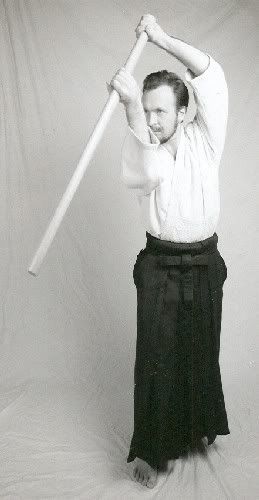
It all started when I was a fanatical aikidoist in my twenties, and started each day with bokken (wooden sword) practice. I always had in mind that my routine, whatever it consisted of at any given time period of my life, was a spiritual discipline, and not just a physical workout (though my aiki weapons routines used to make me sweat very nicely), which meant that the last part of the routine was always meditation.

As life got more complex (read: having to earn a living and nurse literary ambitions) and commitments increased (read: wife and children), I always strove to create the "ultimate" series that was relatively brief, still hit most of the muscles and joints in the body, and prepared the mind for meditation.

In August, while attending the AMORC World Convention in Berlin, I roomed with a member from Hungary. Every morning, he did a short series of five exercises. What got my attention was that they started with an exercise consisting of holding one's arms out, palms down, and spinning clockwise. I was already doing this exercise as part of my morning routine, but I'd picked it up from a book by Joseph Weed that had been out of print since the 1970s; a source I thought was pretty obscure. He showed me a Hungarian translation of the book Ancient Secret of the Fountain of Youth by Peter Kelder. He offered to loan it to me, but since I don't like reading English books in foreign languages, and since I felt I already had "my" routine, I politely turned him down. But I was really intrigued that the spinning exercise was the same as the one in the Weed book, although Weed said it was part of the training of an ancient Greek seeress. (I think the Weed thing is material for a future posting).

So a little over a week ago, I was researching something on the Internet, when I started getting hits for The Five Tibetan Rites, including this video.

Have you ever considered how that element of randomness to Internet searches makes the Internet kind of "oracular"? I mean: I don't know about you, but I seem to often "stumble across" things just at the very moment I need them in my life. Well, this Five Tibetans thing was popping up pretty often, so I decided to go for it. So now I've incorporated them into my morning routine. More than that: they've become the basis of my morning routine. I use a little chi kung twist to warm up my spine, and an aikido weight shifting exercise to get the circulation going in my legs and arms, but the heart of the workout is The Five Tibetans.

It's only been five days, and I can already feel things happening in my body. Yesterday and the day before I kept getting these warm sensations in my lower back like someone was holding a hot water bottle up against it. Yesterday I used it as the warm up for my every-third-day jogging session instead of my usual warm ups. I was bouncing down the sidewalk like a rubber ball the whole way (yee-haa!). Best run I've had in months!

There are all kinds of theories about why it works, and I have some thoughts on that, but I need to get to bed so I can get up and do my exercises in the morning. ;-)

Maybe I'll have to blog about this more later.